
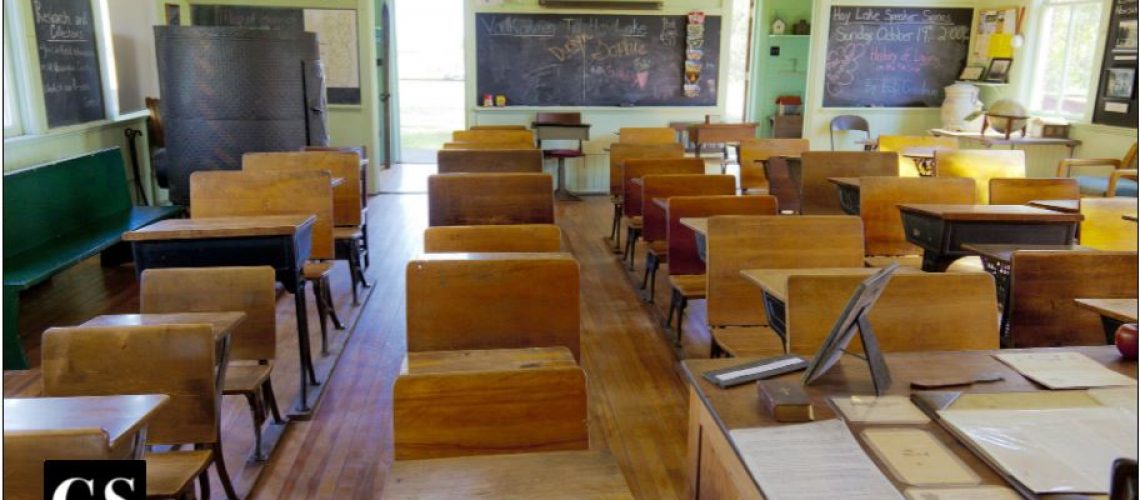
September finds schoolchildren back in the daily routine of lessons and learning. Summer camp and beach days yield to books and structured academics. Teachers return to school, fueled by professional development in the weeks before the students’ first day.
The whole circumstance of pupils and instructors coming together for the benefit of the younger, weaker, and less knowledgeable recollects a verse from Genesis, “God saw that it was good” (Gen 1:31). Instructing the ignorant is a work of mercy. Learning to follow rules and respect teachers builds character suitable to Christian children.
In good public schools, children acquire virtue in addition to academics. But even an excellent school, unless it has a faith foundation, does not necessarily address one key aspect of personal development: spirituality.
Spiritual Needs and Planting Seeds
Parents of faith have long recognized spiritual needs that the public school cannot meet. American public schools, once accepting a Judeo-Christian foundation, have now for several decades aimed to provide instruction free of religious influence. Religious institutions address the spiritual needs of their children by providing instruction apart from public education.
In Catholic schools, children are reminded of God’s presence throughout the school day through faith connections in each subject area. Catholic families for whom parochial school is not an option may foster children’s awareness of God in their studies as well. Dinner table conversations about what is happening in the classroom can be valuable opportunities for this.
Reading is a key subject in school. Parents and caregivers can ask children periodically, “What are you reading at school?” Whether the answer is a fairy tale or Homer’s Odyssey, adults can make connections to the faith. Characters can be analyzed for godly virtues. Plot lines reveal injustice due to characters ignoring the Commandments. Adventures highlight heroism with which God graces people. Perhaps an adult can even manage to obtain a copy of a book being read at school, to discuss later with a child, with the goal of finding faith connections within it.
In other subjects, too, God’s presence can be illuminated. Science provides the window into creation, how God orchestrated animal and plant life, ecosystems and galaxies. Questioning students about history can guide them to analyze the ethical motivations behind political decisions or great historical movements. Mathematics and music have order and complexity that suggest an intelligence higher than ourselves. Art gives humans a chance to create like the Creator Spirit who breathed life into the world.
As children answer these dinner table questions about school, seeds are planted that will bear fruit the next day or the next week. Discussing that novel in class, the child will contemplate the righteous character who stood against evil. When studying the parts of the flower, he will remember Dad’s observation that God created nature with order and detail. In music class, a child can recall Grandma saying that singing is a way to praise the Lord. For the child who has been made more aware of Him, God is evident throughout the day in the public school classroom.
Meeting Moral Conflicts with Christian Charity
While academics can complement children’s awareness of God, public school presents moral challenges to faithful Catholics. Cultural influences that conflict with Church teaching permeate school curricula. In the late 20th century, this influence reflected society’s acceptance of the sexual revolution. Problematic moral topics in today’s public schools have expanded to include issues related to LGBTQ.
Determining an appropriate parental response to moral issues begins with knowing what is happening in school. Parents need to show up for back-to-school nights, parent-teacher conferences, parent advisory councils, and sometimes board meetings. Listening at home to children’s perception of their experiences at school is critical.
Opting out of classes is not feasible, as LGBTQ topics are infused in academic content across the curriculum. Instead, parents may try to help children develop positive Christian perspectives. For example, New Jersey social studies classes recently incorporated lessons acknowledging historic contributions of LGBTQ individuals. Such lessons can help Christian students understand and respect these people. They also provide an opportunity for the discussion at home that, although we find people’s lifestyle not in keeping with our faith, we still respect them as valuable members of society.
A Sensitive School Climate
Parents must understand that children navigate the sensitive climate of school LGBTQ concerns. A judgmental slant will sabotage conversations and paint the parent as a homophobic hater. While this label is inaccurate for most devout Christians, it may be edifying to consider how accusations of homophobia originate. Most older adults can recall, in years past, hearing unkind comments or cruel jokes aimed at people suspected of being gay. On a larger scale, history includes accounts of brutal attacks on homosexual people, hate crimes sometimes perpetrated by tragically misguided ultraconservative Christians. Responding to this, and to alarming statistics of harassed individuals taking their own lives, schools have adopted anti-bullying strategies. Christian parents can certainly support anti-bullying measures.
The primary attitude in any moral discussion must be Christian charity. Every student is a child of God, with value and dignity. Bullying, judgment, and condescension are antithetical to the Way of Jesus.
This is not to say that one must endorse the culture’s errors. We may neither condemn nor conform to those who live contrary to the faith.
Comprehending Catholic Doctrine on Marriage
To understand Church teaching on sexuality, children need to comprehend the beauty of Christian marriage. God’s plan for humanity involves love so powerful that it can create new life. Husband and wife reflect a Trinitarian image, mirroring the eternal exchange of love that is God. The love of Father and Son is another Person, the Holy Spirit. Modeling Christ’s love for the Church, the husband unites himself to his wife, and his love creates new life in her. In these analogies, the male-female union is essential. This is why Christian marriage is defined as the lifelong, sacramental union of a man and a woman.
This explanation of marriage echoes God’s salvific plan, from Adam and Eve in Genesis to the marriage of the Lamb in Revelation. Parents should be secure in their understanding of this doctrine. The writings of Christopher West, Scott Hahn, and John Paul II can be helpful in this regard.
Planned Secrecy
Finally, a set of ideas which Pope Francis calls “gender theory” reaches even elementary school students. Children, many of whom never questioned their maleness or femaleness, are presented with the option to switch genders. Classmates change names and pronouns, or use the pronoun “they” if their chosen gender is non-binary.
Surprisingly, some schools preclude parental response to transgender issues, with planned secrecy. Teachers are instructed not to tell parents if a student transitions to a different gender at school. Schools may not even have a policy that clarifies whether parents will be informed if a teacher introduces transgenderism in class.
Parents are well within their rights to question administrators about school policy regarding transgenderism and parental notification. Discernment is needed. Self-righteous anger will earn parents the label of “homophobic” and perpetuate bias against conservatives. Rather, respectfully and reasonably bringing concerns to school staff is necessary. Teachers and administrators may not be receptive. Other parents and school board members who subscribe to the extremes of modern culture may consider all conservative parents as monsters. Ultimately, though, schools cannot justly refuse parents who request to be informed of issues involving their children.
Parent Response
Family discussion, both listening and talking, constitutes the most important parental response to moral challenges. Charity remains the guiding principle. Catholic parents must reinforce these truths: Each person is a child of God. Each is blessed with a male or female gender, which is God’s gift. Those who do not share our beliefs must be treated with kindness and respect, since each person is a child of God.
While the Church holds that one’s gender may not be altered, it does encourage a flexible attitude toward gender roles. Pope Francis writes that masculine and feminine need not be rigid categories dictating or excluding individuals from favored activities. Children should be encouraged to develop talents even if their interests differ from traditional gender roles (AL 180-181).
In a sense, each new academic term, the entire family goes back to school. Parents can plant seeds that turn a child’s attention to God during the school day, and help children to respond appropriately to cultural moral challenges. These measures bring Christian spirituality into the public school.
Work Cited
Pope Francis. Amoris Laetitia. Huntington, IN: Our Sunday Visitor, 2016.
Works Consulted
Hahn, Scott and Kimberly. Rome Sweet Home. San Francisco: Ignatius Press, 1993.
John Paul II. Man and Woman He Created Them: A Theology of the Body. Translated by Michael Waldstein. Boston, Pauline Books and Media, 2006.
West, Christopher. At the Heart of the Gospel. New York: Image Books, 2012.
West, Christopher. Good News About Sex and Marriage. Cincinnati: Servant Books, 2007.


[…] This site uses Akismet to reduce spam. Learn how your comment data is processed. source […]
[…] Confusion? Ignorance? Or Deliberate Suggestio Falsi? – Fr. John Hunwicke at Mutual Enrichment Back-to-School Spirituality – Mary Ennis Meo at Catholic Stand Pope Francis, the Suspended Issues – Andrea […]
[…] post Back-to-School Spirituality appeared first on Catholic […]