
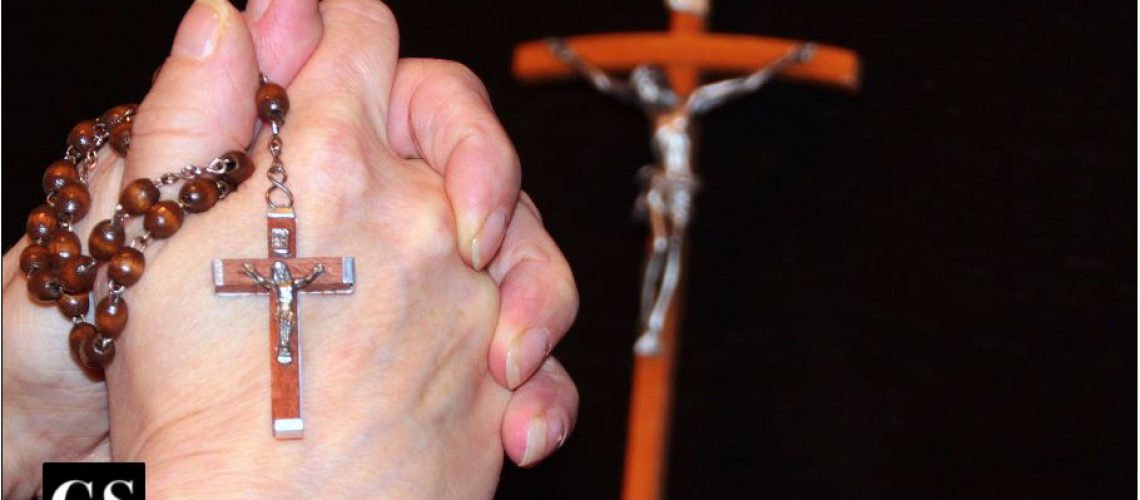
When I was young and in Confirmation class, we were taught there are five types of prayers: Adoration, Praise, Thanksgiving, Intercession, and Petition. That I still remember this is testimony to the power of rote learning!
The “Catechism of the Catholic Church” orders them a bit differently today. It also says prayers of Adoration are actually prayers of Blessing and Adoration.
You may note, however, that contrition is absent from this list. This is because it was and is considered a necessary part of the sacrament of Reconciliation (in my antiquity, known as Confession) and an advisory element in all of the other types.
, more often than not. I don’t know when that grouping started, and I haven’t found an explicit explanation for it. Given my personal difficulty with both types at various times, I might suspect any number of things, but I’d rather admit to my difficulties and let others make what they will of that.
Feeling And Thinking In Prayer
One might list the types of prayer above in any order, but I use the order in which I was taught, and the order that C. S. Lewis uses in “Letters To Malcolm: Chiefly On Prayer” (well worth reading). One thing I notice in this order is the types are listed in descending order of emotional content and ascending order of intellectual access.
By the time one reaches Thanksgiving, it is easy to substitute list making for feelings of gratitude. Similarly, by the time one reaches petition, thoughts of what we need and feelings about what we need are, for most of us, naturally integrated. Indeed, it is usual for many people to interject thinking for feeling when praying about perceived needs. This keeps the list manageable and outside the realm of frivolity or selfishness.
But in prayer, as in many human things, one size does NOT fit all.
I am a person who lives in my head. As such, my gifts tend to the intellectual and not the emotional. So my comfort zone is definitely skewed in that direction. To me, prayers of adoration and praise have always seemed to involve more feeling than thinking. And this is one reason I think I have found prayers of adoration and praise more challenging.
Nice Little Cosmos You Made Here, God
Praise, for example, always gives me a sense of discomfort. On some level prayers of praise seem oddly presumptuous. It brings to mind C.S. Forester’s novel “Flying Colours,” about the heroic British Navy Captain Horatio Hornblower’s escape from France before his execution.
In the novel Hornblower escapes prison and at first hides out with the family of a French aristocrat. Then he takes a skiff down a river to a port where he steals a previously captured British revenue cutter. He makes his way out into the channel, finds a British warship and returns to London. Eventually he is presented to King George. George tells him his was a nice piece of work, and he (the King) “couldn’t have done better himself.”
(This was the same King George recently released from regency because of his insanity, once thought to be due to porphyria, but now attributed – possibly – to bipolar disorder).
I mention this story because an overweight and not always mentally balanced man telling another man his incredible feats of courage and daring-do were admirable because he “couldn’t do better himself” stuck with me. It brings to mind the occasional feeling of foolishness I feel in prayers of praise: “Nice little universe you made here God – I completely admire your work.”
The Book of Job
I then think of God answering Job in chapter 38:4-11 –
Where were you when I founded the earth?
Tell me, if you have understanding.
Who determined its size? Surely you know?
Who stretched out the measuring line for it?
Into what were its pedestals sunk,
and who laid its cornerstone,
While the morning stars sang together
and all the sons of God shouted for joy?
Who shut within doors the sea,
when it burst forth from the womb,
When I made the clouds its garment
and thick darkness its swaddling bands?
When I set limits for it
and fastened the bar of its door,
And said: Thus far shall you come but no farther,
and here shall your proud waves stop?
My emotional response is a desire to slink out by the nearest door.
A Snare and A Delusion
This is a “snare and a delusion” springing from false humility and an emotional distance from God that leaves me uncomfortable with what springs naturally from humans as a part of affection. Yet there is nothing of condescension in our heartfelt praise for the accomplishment of a friend or a child, just genuine admiration and love. Why is this, I wonder?
The gentle self-criticism for this difficulty is that it comes from un-moderated awe. The less gentle is that it comes from fear: the fear of facing the un-navigable disparity between the glorious Author of Creation and me, a tiny consumer and partial observer of His work.
That God Himself became flesh to bring us the grace to approach Him with something other than paralyzing fear is something of a consolation. But both my ego and my sense of my own absurdity leave me with plenty of discomfort, none the less.
This brings me, even more uncomfortably, to Adoration.
“What Is Man, That You Are Mindful Of Him?”
This line, Psalm 8:5, captures part of the dilemma of adoration. While it refers prophetically to Jesus, it also refers to us in that God would become flesh for our sake. Who, indeed, are we that God would be so mindful of us as to take on our form?
A dictionary definition of “adore” includes an essentially self-referential statement about worshiping a deity and a more human scale involving love, admiration, and devotion.
I was so good at human adoration that at one mercifully brief point in Jr. High I could develop 3 or 4 crushes walking through the hallways in the 5 minutes between classes. And each was more powerful than the one before. Fortunately the hormone storms responsible faded in an also mercifully short time. I adapted to puberty and the understanding that such crushes were rarely mutual. (Another mercy!)
I suspect that my mercurial adolescent heart (which sounds so much better than fickle) may be one reason I am uncomfortable with adoration.
Later this year my wife and I will celebrate 50 years of marriage. We met in college, and it turned out we had every class together but one. (This is not as coincidental as it might sound because at St. John’s College, the Great Books School, everyone had the same classes. We just happened to be in the same classrooms at the same time.) We liked each other quickly, but we spent our first year arguing and quarreling as often as not.
One might argue that 50 years of marriage speaks to some level of love, admiration, and devotion. I think that argument would be successful. But it would also be incomplete if it left out forbearance, tolerance, a capacity to recover from annoyance, and any number of supporting feelings and disciplines.
Maybe My Understanding of Adoration Is Too Limited
I have already admitted that my ego balanced by a sense of the absurd have helped me somewhat with prayers of praise. I think that bringing the experience of marriage to apply can help me with adoration.
We are taught that Christ is the bridegroom and the Church is the bride. Jesus may be a perfect bridegroom, but we as individuals are not perfect. Perhaps my 50 years of experience in the practical living out of human adoration might help bring me closer to understanding how to practice adoration in prayer.
I notice, for instance, that while I was quite free to express annoyance with God when I prayed in my younger days I am reluctant to do so now, at least compared to the freedom I seemed to feel then.
I have lost a lot of arguments with God over the years; I may have become too reluctant to fight it out. But even after knowing each other for almost 52 years, my wife and I still fight things out, though not as often. After all, after 52 years we have managed to settle some things. But we have the advantage of sharing a similar win/loss ratio.
God, on the other hand, has the overwhelming advantage in my quarrels with Him. Even when I win it is because someone gets my attention and points out that I misunderstood where God was in the controversy I had manufactured.
In short, I think I have labored under the misapprehension that when it came to prayers of adoration, my adoration had to be divine and not actually human.
How to Address These Weaknesses
I previously mentioned “Letters To Malcolm: Chiefly On Prayer” by C. S. Lewis. In one of these letters Lewis points out a natural flow from one type of prayer to the next. After acknowledging the majesty and glory of God in adoration it is natural to move on to praising him. Then, after praising him, it is natural to thank him. And after thanking him we might ask him to do for others. Having prayed for others, we can then feel free to pray for ourselves.
It occurs to me that Lewis’s progression could work as well in the opposite direction. After listing those things for which I am thankful, I may find it easier to praise the God who has given me these things to be thankful for. And after praising the God to whom I am thankful, it could be easier to fall into adoration.
Of course a good spiritual director could probably have set me in this direction years ago . . . but some things work better if we have to figure them out ourselves.
Prayer
Lord, free us from the limitations of ego and false humility, and open our hearts to know that you welcome us as we are, knowing that when we welcome you we will be blessed with Grace to grow. Lead us to genuine praise and full adoration of your holy presence in and beyond this wonderful world you have set us in, and lead us on to the perfect bliss of life in your eternal presence. Amen.


Thank you for taking the time and effort to write the article and maintain your website.
I found your page while looking for examples of rote prayers of praise.
But, it is puzzling that you would write an article on prayer, then without correcting your article simply note the differences between your opinion and what is written in the Catechism of the Catholic Church.
Blessing, Petition, Intercession, Thanksgiving and Praise are the noted forms of prayer in the CCC. While Adoration may be what you remember, from your childhood, it is really a form of Praise.
Why do you think the Church has gone through the effort to document how it classifies prayer, but you would express them a bit differently?
Referring to the CCC 2623, Blessing and Adoration are discussed together in this and the following paragraphs – so it is not really a difference worth splitting hairs over.
I guess I was just a little disturbed that someone, with good faithful intensions, would knowingly publish an article which differs from the teachings of the Church they propose to be following/supporting.
[…] Neck Scarves: Don’t Get Hung Up by Summer Heat – Meghan Ashley Styling/Catholic Mōdê Blog Prayers of Adoration & Praise – Mark Belanger at Catholic Stand Friends & FOCUS: Amber Cybulski’s Conversion […]
Your article made me think of my own experience of learning to fully experience adoration and praise.
My years of traveling for work and subsequently seeing so many different wonders of creation in the US have made Adoration and Praise to and for God our Creator second nature to me. I cannot count The times that I have walked upon a truly majestic site and been filled with awe and wonder and then had praise to God rise inside me. Often my prayer comes forth as I spontaneously sing that great old Hymn How Great Thou Art
“ oh Lord my God when I, in awesome wonder, consider all the worlds the hands have made………..
Then sings my soul, my Savior God to Thee, how great thou Art. How great thou art.“
How nice! That was one of our hymns this Sunday.
Thank you!
Mark
Faith and trust in God need to undergird everything we do in life including our different types of prayer.
I absolutely agree! Thank you for your comment.