
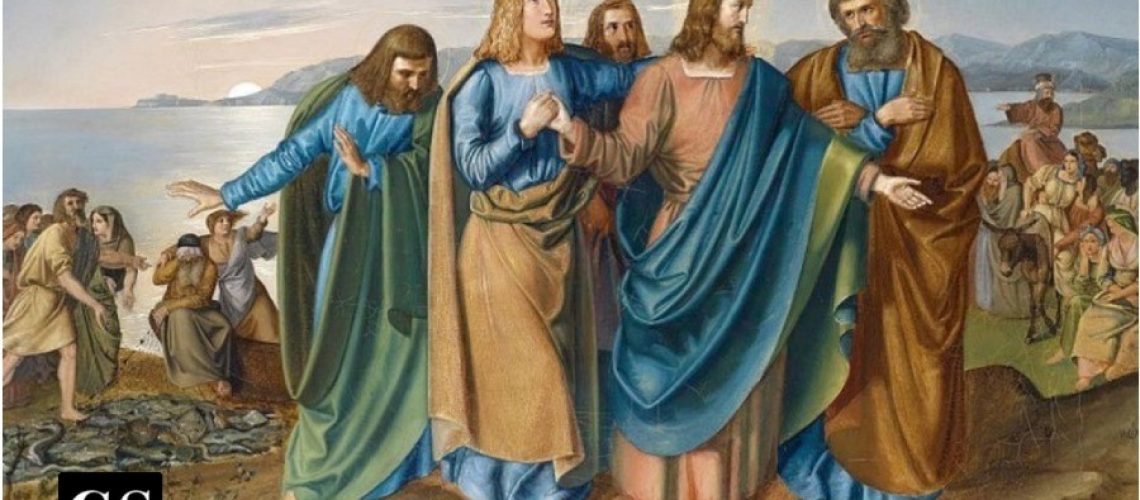
Then the same day at evening, being the first day of the week, when the doors were shut where the disciples were assembled for fear of the Jews, came Jesus and stood in the midst, and saith unto them, Peace be unto you (John 20:19 ).
INTRODUCTION
At a recent Calix Society zoom meeting, the Lectio Divina reading was the Sunday gospel. In the sharing after the reading, a member commented on Jesus’s greeting:
‘peace be unto you.’ Such peace is the goal of the 12 Steps, Our Catholic faith is the means whereby we achieve this peace.
I agree. Let’s delve into the etymology of “peace.” And let’s examine the connection between peace, the 12 Steps, and Catholic teaching.
“SHALOM” = “PEACE BE WITH YOU” AND MORE
I pointed out that “Shalom” is the standard Jewish greeting that Jesus would use to greet his disciples. The English translation of “shalom” is “peace.” But there is an additional layer of meaning to “shalom” in Hebrew. (See here for a complete account.) As the linked article notes, the root word of “shalom” is “shalam”, which means “to make whole,” or “to restore.” Shalom carries this connotation of wholeness or well-being, as shown in Joseph’s greetings to his brothers when they came before him in Egypt:
And he asked them of their welfare, and said, “Is your father well, the old man of whom ye spake? Is he yet alive?” And they answered, “Thy servant our father is in good health, he is yet alive (Gen 43:27-28).
“Welfare,” “well-being,” “good health,” etc. are all connotations of the Hebrew “shalom.”
Now, where does this connect with Catholic teaching and the 12 Steps? Although the connection with Catholic teaching (“shalom” as “peace”) should be obvious, that with the 12 Steps is not. So I’ll discuss that first, below.
SHALOM AND THE 12 STEPS
For those who are not familiar with the 12 Steps, please go here or here for a short account. Since the space for this article is limited, I won’t give a detailed explanation of where “shalom” fits the program. Rather, some examples will, I hope, make my point.
In his fine book, “By the Grace of God,” Rev Francis Canavan, S.J. has given 52 articles, drawn from his homilies. Amongst the titles are several that suggest why “peace,” “well-being,” and “wholeness” are goals of the 12 Steps. I’ll list some of these below:
- “The Bondage of the Past;
- “Coming to Terms with the Past;
- “Damaged Goods;
- “Good Orderly Direction;
- “How Sick I Still Am;
- “Growth;
- “Happiness.
- “Inventory and Confession
Although there are more, these will, I hope, paint a picture. When we, as addicts or alcoholics, look at ourselves, we see someone who is deficient, who has committed wrongs to others and to him-/herself and is not at peace with who he/she is. The 12 Steps, particularly Steps 4 through 9, help us to look at ourselves through the telescope of recovery, given by the grace of a loving and forgiving God. And this last is where the connection between the Catholic faith and “shalom” lies.
“SHALOM” AND CATHOLIC TEACHING
After the Lord’s Prayer in Mass, the Salutation “Peace be with you” is given by the priest and shared by the congregation. In this sign of peace (suggested by St. Augustine of Hippo in the 4th century), there are also layers of meaning. When we recall Jesus sending the disciples out, He tells them
And when ye come into an house, salute it. And if the house be worthy, let your peace come upon it: but if it be not worthy, let your peace return to you (Matthew 10:12-13).
What is “salute it?” It is the greeting “Shalom, Peace be with you.” The peace that is not only calm and contentment, but wholeness, well-being, fitting-in. In short, the peace that comes with accepting God’s Will.
Inquiring into the deeper meaning of “peace,” Dr. Donald DeMarco, goes back to St. Augustine of Hippo.
For the Bishop of Hippo, peace is the “tranquility of order” (tranquillitas ordinis). Augustine is referring to the personal experience of peace. Human beings have lived disorderly lives ever since they were wounded by Original Sin. Their souls became “restless”. This restlessness (inquietum) created a longing for peace. But peace would always remain elusive as long as it is regarded as a direct object of choice (Dr. Donald DeMarco, linked above).
According to Dr. DeMarco, the order that one should seek is the order that comes from submission to God, from doing that which God wishes As the famous quote from St. Augustine puts it
Our hearts are restless and will not find rest until they find rest in You (St. Augustine, Confessions).
Peace is accepting injuries and loving, praying for the one who injures us. Peace is accepting God’s will: that He gives Grace to us to recover from addictions and that we are powerless other than to accept His grace. Thus, that rest, that peace which passes understanding, is that which we seek in the Trinitarian God.


[…] New Notre Dame Football Coach Resurrects Pregame Mass Tradition, & More Links – The BICB Shalom! Peace Be with You! Catholic Teaching & the 12 Steps – B. Kurland, Ph.D./Catholic Stand Is Foul Language Necessary to Share the Faith Credibly? […]