
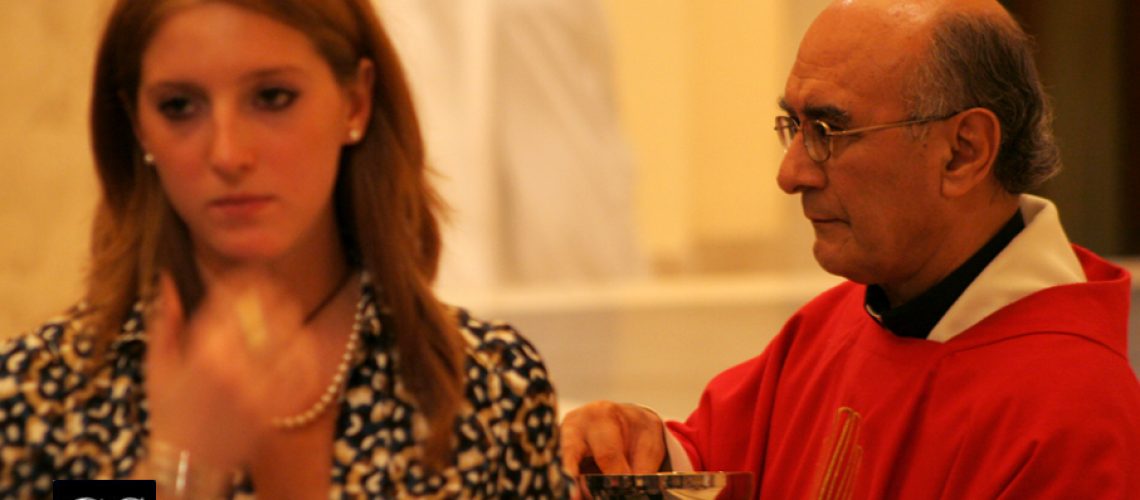
It is a common practice to pull a credit report on a person applying for a job or a loan. In fact, your credit score factors into just about every major transaction these days. A number is calculated based on timely (or untimely) repayment of loans and existing indebtedness. “Credit Worthiness” is based on a three-digit number. What if a “Catholic Worthiness Score” were able to be calculated? Could a person with a low score be denied Communion or other Sacraments?
As far-fetched as the above might sound, there is a tendency to assign a subjective score of some kind to others, especially public figures. There is a “Court of Catholic Opinion” that is perpetually in session, while never yielding a final verdict.
A lot of ink has been spilled over what it means to be a “Catholic in good standing”, and who is or is not in full communion with the Church. Receiving Communion while not being in a state of grace and separated by unrepented mortal sin is as serious as it gets in the Catholic Church. The reception of Communion “in an unworthy manner” will be judged by the Lord. It is important to note that condemnation and guilt are not determined by a “jury of peers”, and any baptized person “can and must be admitted to holy communion”. There are exceptions listed in the Code of Canon Law, as listed below:
Can. 912 Any baptized person not prohibited by law can and must be admitted to holy communion.
Can. 915 Those who have been excommunicated or interdicted after the imposition or declaration of the penalty and others obstinately persevering in manifest grave sin are not to be admitted to holy communion.
If a public official has been “prohibited by law” or is “obstinately persevering in manifest grave sin”, then a case could be made for being denied holy communion. The problem, of course, is that there is no effective way of determining in real-time if any given person meets the criteria for not being “admitted” to receiving during Mass.
It is interesting to note that the seven capital (deadly) sins if committed in “obstinate perseverance”, are virtually undetectable to others. A person right smack dab in the middle of the sin of pride can slip into the communion line with the greatest of ease. Would that be wrong? Yes, objectively speaking. Who would know? Only God and that individual. St. Paul explains personal accountability this way:
Whoever, therefore, eats the bread or drinks the cup of the Lord in an unworthy manner will be answerable for the body and blood of the Lord. Examine yourselves, and only then eat of the bread and drink of the cup. For all who eat and drink without discerning the body, eat and drink judgment against themselves. For this reason, many of you are weak and ill, and some have died. But if we judged ourselves, we would not be judged. But when we are judged by the Lord, we are disciplined so that we may not be condemned along with the world (1Corinthians 11:27-32).
“Mind your own business” is an expression that is applicable in the world as well as in the Church. It refers to steering clear of another’s affairs while attending to your own. Getting worked up over someone else’s possible sins is an exercise in futility. There is simply no way for anyone to determine the state of another soul’s contrition, penitence, and disposition during communion. This concept is made clear in the following passage:
Do not judge, so that you may not be judged. For with the judgment, you make you will be judged, and the measure you give will be the measure you get. Why do you see the speck in your neighbor’s eye, but do not notice the log in your own eye? Or how can you say to your neighbor, ‘Let me take the speck out of your eye,’ while the log is in your own eye? You hypocrite, first take the log out of your own eye, and then you will see clearly to take the speck out of your neighbor’s[c] eye. (Matthew 7:1-5)
Let us pray for the grace and strength to tend to the “logs” in our life while dealing with the “specks” in others with graceful and charitable hearts.


[…] Meghan Ashley Styling Bishops Spinning the Truth in Baltimore – Tom Basile at Crisis Magazine A Catholic Worthiness Score? – Deacon Greg Lambert at Catholic Stand Bishop Strickland Challenges HHS Sec. Becerra’s […]
We need to identify the distinction between condemnation or being judmental and telling the person he ought not to receive communion on matters of grave moral scandal especially when somebody is publicly endorsing abortion.
COWARDS would just say “Who am I to judge?”
I take with St. John the Baptist who took the choice of telling the person what is right even to the point getting beheaded.
With all due respect, Deacon Lambert, the key provision in Canon 915 is not merely grave sin. (In the case of private grave sin, it is the responsibility of the communicant to hold back, rather than the minister, and that is covered in Canon 916.)
The key is MANIFEST grave sin–sins that the individual is known to the public to have committed and not repented for–and the concern is not the communicant’s worthiness to receive, but rather giving the false implication to others that the communicant’s publicly known sin is acceptable, thus leading them into error–in other words, the sin of scandal.
Avoiding scandal is the primary concern of Canon 915.
Abortion is a moral evil. Every time a political/celebrity figure with a wide public reach proclaims it as an act of compassion, that life does not begin at conception, and/or other egregious claims …while proclaiming they are “devout” Catholics must be corrected in an equally public forum, loudly and continuously, in the strong unanimous voice of Catholic leaders and all those who are united to the Catholic Church. These “devout” Catholic leaders are creating a scandal with their proclamations supporting a moral evil and other anti-Christian stances. They have taken the word “devout” and connected it to a moral evil. As long as these leaders continue with their efforts to push abortion and infanticide, gender fluidity and other grave error ridded practices…then they should not present themselves as worthy to receive the body and blood of our Lord…Jesus Christ. They are mocking Him with their Sacrilege…wiping their feet on His sacrifice.
This is a timely and important reminder. Thank you!