
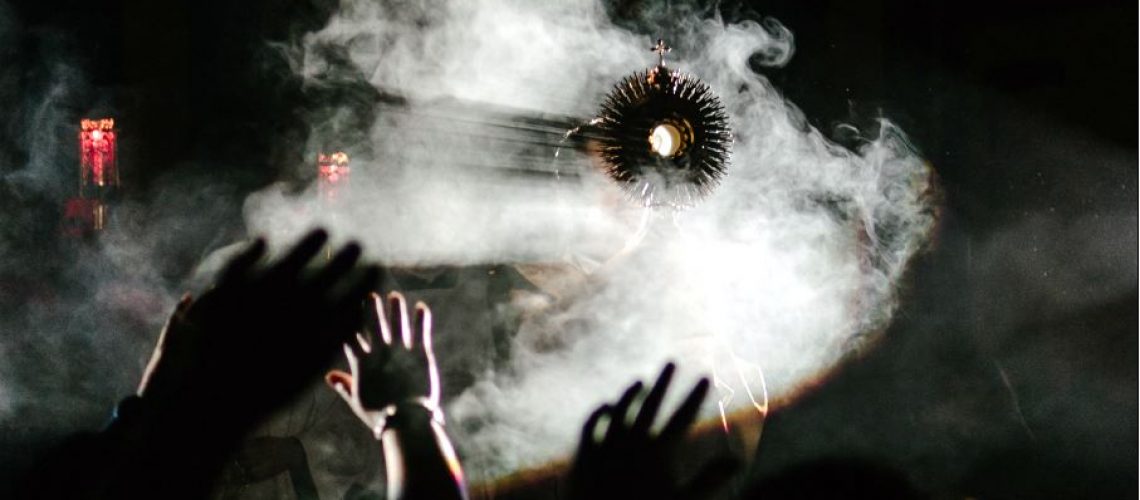
I was a Catholic in my heart and spirit for more than a year before I was able to receive the sacraments. I was baptized into the Church at the Easter Vigil, so that particular Easter was my first time officially receiving the sacraments. Being that the Eucharist is the completion of Christian initiation (CCC 1322), there was a long span of time when I was only allowed to be Catholic intellectually and spiritually without partaking of the sacraments.
Many Catholics across the U.S. are finding themselves in the same situation as the COVID-19 pandemic rips across the country. Most dioceses are placing restrictions and limitations on the reception of the sacraments, some postponing them altogether. Masses are streamed online, and many Catholics are left starving for the sacraments.
The Reality of Spiritual Communion
Incredible longing and desire for the sacraments (especially Holy Communion) isn’t a situation altogether new to the Church in this current pandemic. There have been many times and places in church history where restrictions were placed on Mass, and Christians longed for the Eucharist. Spiritual communion, defined as a constant desire to be united with God in the Eucharist, was the way of maintaining union with God. Persecution, sickness, and wars are things that have paved the way for many situations in which spiritual communion has been needed and emphasized in the Church.
In Pope John Paul II’s encyclical, On the Eucharist and Its Relationship to the Church, he says the following:
In the Eucharist “unlike any other sacrament, the mystery [of communion] is so perfect that it brings us to the heights of every good thing: here is the ultimate goal of every human desire, because here we attain God and God joins himself to us in the most perfect union”. Precisely for this reason it is good to cultivate in our hearts a constant desire for the sacrament of the Eucharist. This was the origin of the practice of “spiritual communion”, which has happily been established in the Church for centuries and recommended by saints who were masters of the spiritual life. (Ecclesia de Eucharistia, 34)
Thomas Aquinas and Spiritual Union
St. Thomas Aquinas believed God communicates His grace to souls who desire Communion but cannot receive it sacramentally for one reason or another. He believed that the desire for Christ in the Eucharist efficaciously results in the same effect in the soul as having actually received. According to Aquinas,
…before receiving a sacrament, the reality of the sacrament can be had through the very desire of receiving the sacrament. Accordingly, before actual reception of this sacrament, a man can obtain salvation through the desire of receiving it, just as he can before Baptism through the desire of Baptism…. (ST III. Q.73, A.3)
Aquinas and the Angels
St. Thomas also believed that the angels feed on Christ spiritually. Aquinas makes the distinction between the ways in which humans and angels feed on Christ in a spiritual manner. The angels feed on Christ in His proper species, directly, united with Him in perfect charity, while humans feed on Him sacramentally, united with Him by faith.
Aquinas elaborates on this distinction by saying that
Christ Himself is contained in this sacrament, not under His proper species, but under the sacramental species. Consequently, there are two ways of eating spiritually. First, as Christ Himself exists under His proper species, and in this way the angels eat Christ spiritually inasmuch as they are united with Him in the enjoyment of perfect charity, and in clear vision (and this is the bread we hope for in heaven), and not by faith, as we are united with Him here. In another way one may eat Christ spiritually, as He is under the sacramental species, inasmuch as a man believes in Christ, while desiring to receive this sacrament; and this is not merely to eat Christ spiritually, but likewise to eat this sacrament; which does not fall to the lot of the angels. (ST III. Q80, A.2)
Make an Offering
We may be limited now in that we cannot receive Communion sacramentally, but we can stoke desire in our hearts like burning embers in a fire and rejoice in our longings for Christ. We can pray that when we do receive Him again in Mass, that we receive Him all the more reverently. Romans 12:1 invites us to “Offer yourselves as a living sacrifice to God, dedicated to his service and pleasing to him. This is the true worship that you should offer.” We can offer up our holy desire to be united to Christ sacramentally and pray that the flames of desire in our hearts don’t fan out.
St. John Marie Vianney also commented on this burning desire for the Eucharist: “Communion is to the soul like blowing a fire that is beginning to go out, but that has still plenty of hot embers; we blow, and the fire burns again,” he said. Then he added: “After the reception of the Sacraments, when we feel ourselves slacken in the love of God, let us have recourse at once to spiritual communion. When we cannot go to the church, let us turn towards the tabernacle; no wall cannot separate us from the good God.”
Where the Church Is
It is not easy going for such an extended period of time without the sacraments. However, we must remember that we are not hopeless. We are still united to Christ via His Church whenever the priest celebrates Mass. The Catechism of the Catholic Church says “By the Eucharistic celebration we already unite ourselves with the heavenly liturgy and anticipate eternal life, when God will be all in all” (CCC 1326).
Before I was able to receive the sacraments I prayed daily that, when I would finally be able to receive, Christ would give me the grace to receive Him all the more blessedly and reverently. Though we cannot receive Him yet sacramentally, let us spiritually unite ourselves to Him through acts of spiritual communion. And the next time we receive Him sacramentally, let us tremble before Him in reverence and holiness giving Him thanks always for His great love for us and for His Holy Church.


According to Our Lord we must receive Him if we want to be with Him in Heaven.
Thank you.
Prior to the papacy of St. Pius X, it was common for most Catholics to receive Communion only a few times each year. He not only encouraged frequent Communion, but lowered the age of first reception in 1910 from 12 to 7 years. It was the introduction of evening Masses in 1953 that changed the pre-communion fast from midnight, which included water, to three hours for food and one hour for water. This was extended to all Masses in 1957, followed by the current 1 hour rule with no restriction on water in 1983. Consequently, reception of Communion is now the ordinary and appropriate practice of all those attending Mass, the sacrifice of reconciliation at which we consume the Lamb of sacrifice.
We often think in terms of our receiving Communion, rather than considering the astounding fact that Christ wants to come to us. It is baffling that He should have cut off essentially the whole world from attendance at Mass. He no longer comes to us. We long for the day when we can say and hear, “I found him whom my soul loves. I held him and I would not let him go.” (Song of Songs, 3:4).