


Whether at the beginning of a new liturgical year, or any other time during the year, we can benefit from taking a look at where we are spiritually. Looking over the past months or year, where have I cooperated with God’s grace and taken advantage of spiritual growth opportunities that He’s given me? Am I on or off the path to sanctity?
For example, regarding spiritual growth, perhaps I’d like more consistency in my prayer life, or to attend more Masses during the week. But in spite of all my best intentions, it just never happens. Perhaps when I look back on my sacramental confessions, I see patterns of sin I’ve continually brought for absolution, and yet nothing seems to change.
Sainthood and the Rule of Life
A rule can help with these and other elements of our spiritual life. If you use a simple rule of life, you can begin to make the progress you’ve been hoping for. You will be able, with God’s grace, to grow in sanctification over time.
To that end, recall that Our Lord tells us to pursue holiness in Matthew 5:48: “So be perfect, just as your heavenly Father is perfect.” This command is not just for a few ordained or professed people, but for each and every one of us.
Dan Burke noted in an Avila Institute course that many of the canonized saints of the Church have something in common beyond demonstration of heroic virtue, miracles attributed to their intercession, or martyrdom for the faith. Many of them were members of religious orders. And religious orders typically use a rule to guide their members not only in living together, but in the imitation of Christ in their lives. And those early saints benefitted from their orders’ rules of life.
A Rule Helps Form Us
Each religious order has its own rules and constitution to guide its members in the pursuit of holiness. For example, Benedictines follow St. Benedict’s Rule, developed in the sixth century for monastics living in community. We don’t need to belong to a religious order, or private association of the faithful, to benefit from a rule of life, though.
A simple rule of life can help keep us on a path toward deeper intimacy with the Lord, developing operative good habits done with ease— that is, virtues. As well, it can assist us in knocking down the bad, or sinful, habits that present obstacles to God’s grace in us.
Begin with Prayer
A rule of life for a lay person needn’t be complicated. It provides a structure for the practices you intend to carry out in your interior life. For example, you can begin with your prayer practices. The morning offering prayer is a great way to start every day, and to make every day, and all that you do in it, an act of prayer.
And mental prayer—Lectio Divina, meditation with Scripture—is a must for us to really know God in a heart-to-heart way. We don’t develop deep relationships with other people by spending only an hour or two a week with them. Neither will we develop a deep relationship with Our Lord unless we consistently spend quality time with Him.
Mass, Communion and Reconciliation
A rule of life ought to take into account the frequency we expect to attend Mass and receive Communion, and how often we plan to take advantage of sacramental confession. We ought to make it to the sacrament of Reconciliation at least monthly unless we’re aware of grave sin in between the regular monthly confessions.
Adoration
Do you spend time in front of the Blessed Sacrament, the Real Presence of Jesus? If your parish or one near you exposes Jesus for adoration and benediction, consider taking time periodically to sit with Him. If the Blessed Sacrament is not exposed, you can still sit with Jesus, who is present in the tabernacle. Many make this part of their rule of life.
Rosary and Chaplets
Our Lady has told us multiple times to pray the Rosary. This also is something we can include in a rule of life. And how about chaplets? The Divine Mercy chaplet is a key devotion that only takes about seven to ten minutes a day to pray. There are other chaplets and devotions that individuals may have some preference for as well. We can note these in our rule of life also.
Spiritual Reading
We all will benefit from pursuing ongoing formation in the faith through, at the very least, spiritual reading. Reading good, orthodox books on the faith can be a boon to one’s interior life. We can include this activity in our rule of life as well. Focus on good, orthodox Catholic authors, including the many great saints and living saints-to-be, such as St. Francis de Sales, Thomas a Kempis, St. Teresa of Avila, Fr. Wayne Sattler, Sr. Mary David Totah, and many others. Gain inspiration from the lives of the saints–St. Therese of Lisieux, St. Frances Cabrini, St. Antony of the Desert, St. Ignatius of Loyola, the Desert Fathers, and more.
The Prayer of the Church
If you belong to a religious order or private association of the faithful, such as the Secular Franciscans, Benedictine Oblates, or Apostoli Viae, you may have committed to pray one or more hours of the Divine Office—Liturgy of the Hours—per day, and this would become part of your rule of life.
Spiritual Growth Opportunities
Based on a review of your existing patterns of thought and behavior, you might identify a key area to focus on for growth in some virtue. Keeping track of that by way of monitoring it through your rule of life can help you stay focused and keep going, even if or when an occasional setback occurs.
Examine Your Progress Daily
It’s recommended that your rule of life include a daily examen. At the end of the day, it’s good to do a quick review of what you and the Lord have been up to. This process takes only a few minutes. It can be as simple as reviewing your blessings for the day, as well as your failings, and ending up with one thing you’ll address the next day.
An Example
The following table shows an example of how you can track your progress on a rule of life that is both basic and robust. This person’s overall goal is to live a more consistent life of faith in order to grow closer to God. Their rule of life, for this example, includes a daily morning offering prayer and mental prayer, as well as a daily Rosary, daily chaplet of Divine Mercy and daily examen. Mass attendance will be weekly on Sundays, with the intention of picking up one more Mass during the week. Confession will be monthly. Through discussions with their spiritual director, this person has begun working on the virtue of patience—at home, and at work.
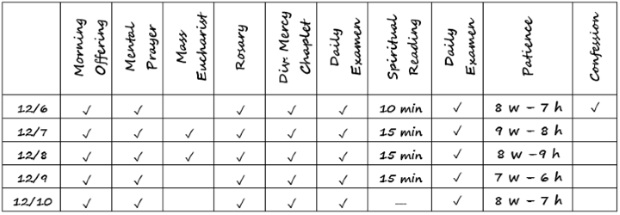
In the above example, the checkmark indicates that the activity was performed on the days indicated.
For the spiritual reading goal, the amount of time spent is shown. However, you also could just use a check mark to show that you completed it. The horizontal line or dash in the bottom of this column at 12/10 indicates it didn’t happen that day.
For work on the virtue of patience, this example shows the use of a 10-point scale, although a 5-point scale would suffice as well. This shows the person’s estimate of his or her success at work (w) and at home (h).
Since confession is set for once a month (unless one is aware of grave sin in between those times), this column would only show the dates when confession occurred.
A Matter for Prayerful Discernment
As with other key matters, developing a rule of life requires prayerful discernment. Consider why you’re including an activity in your rule of life, and how you plan to carry it out. Does it help you to get to know Jesus better, to get closer to Him?
You see, it’s not a matter of “checking the box,” but really is about praying and acting, with and from, your heart. Discussing your proposed rule or changes in it with your spiritual director can help you arrive at something that’s well- grounded and reasonable based on your circumstances.
Especially at the beginning of a new year, it’s good to create or update your rule of life. It can help provide spiritual consistency in all that you do, to more faithfully imitate Christ.
God is the first author of our holiness, the source of our perfection, but we must labor at removing the obstacles that hinder His action in us (Bl. Columba Marmion, OSB).





1 thought on “The Rule of Life: A Path to Sainthood”
Pingback: SVNDAY LATE-AFTERNOON EDITION - BIG PVLPIT