

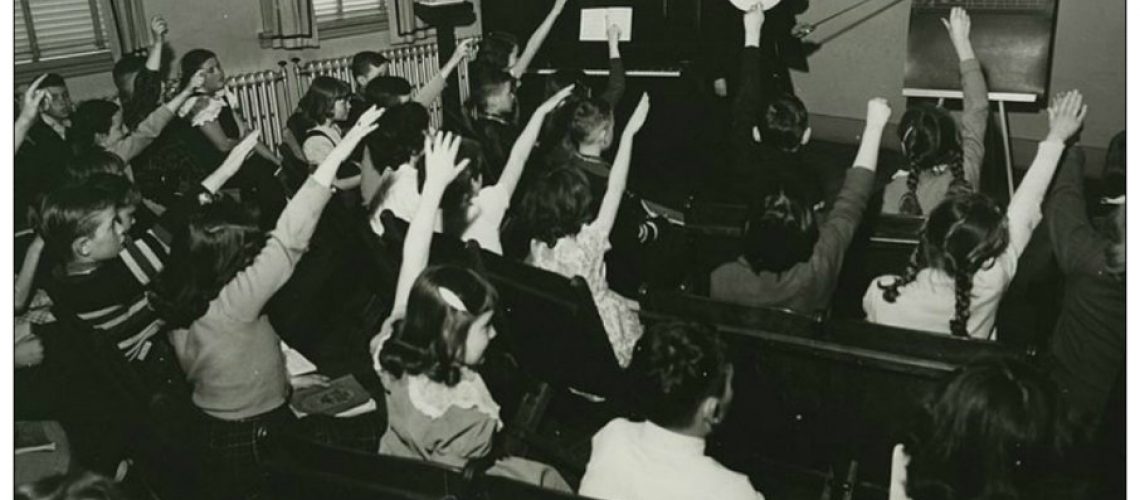
Catholic educator and author Michael Pakaluk began a recent essay at The Catholic Thing with the words “When I taught CCD . . .” Upon reading that I wondered, how many Catholics today know what CCD means?
There are many catechesis (religious education) programs in use in dioceses, parishes, and parochial schools today. Today these programs go by various names – religious formation, faith formation, or, as in my parish, discipleship formation. But it’s mostly Baby Boomers who still call religious education ‘CCD.’
CCD
Youngsters attending parochial grade schools in the mid-1900s learned about their Catholic Faith in religion classes, usually taught by nuns, other religious, or clerics. And in the mid-1900s religion classes were similar throughout the U.S.
Catholic kids who were in the local public schools, however, attended classes after school, in the evening, or on weekends classes to learn about their Faith. These classes were also very similar throughout the country. They also mirrored the classes taught at parochial grade schools.
The similarity in all the classes was because both the classes in parochial schools and the classes for kids in public schools were all “CCD classes.” They were developed under the guidance of the Confraternity of Christian Doctrine, CCD.
Today, however, the CCD no longer provides guidance for the religious education programs being taught in the U.S.
The Confraternity
A Confraternity is simply “a voluntary association of the faithful, established and guided by competent ecclesiastical authority for the promotion of special works of Christian charity or piety.” The CCD was an association of Catholics established up to provide instruction in the Catholic Faith. It was established in Rome in 1562, in part to counter the effects of the Reformation.
For centuries, Missionaries brought the Faith to newly discovered lands, and set up parishes. Once a parish was functioning, the job of educating Catholics fell to the local ordinaries and parish priests. The CCD provided much needed help in this endeavor.
CCD’s spread throughout Europe in the late 1600’s and 1700’s. In 1905, thanks to Pope Pious, they finally found their way to the U.S.
In 1905 Pope Pius X decreed, in his encyclical Acerbo Nimis, that each and every parish throughout the world should have a Confraternity of Christian Doctrine. And some still do, but in many dioceses and parishes CCD is just an old, no longer used acronym.
Some 1,935 CCD associations sprang up in the dioceses and archdioceses in the U.S., each headed up by a director of religious education. These CCDs guided and assisted religious formation efforts at schools and parishes in each diocese.
Luckily, for Catholics in the U.S., the CCD also had the ready-made “The Baltimore Catechism” to assist in efforts to educate U.S. children in the faith. It was first issued in 1885 and was revised by a committee of American Bishops in 1941. Today, however, “The Baltimore Catechism” has fallen from favor.
More Catholics, Fewer Catholic Schools, No CCD
In 1965, 5.5 million Catholic students attended more than 12,000 Catholic grade schools and high schools in the U.S. But these numbers steadily decreased in subsequent years. By 2017 there were only about 1.9 Million Catholic students attending just 6,429 Catholic grade schools and high schools.
Yet these lower numbers do not reflect a decline in the number of Catholics in the U.S. There were 45.6 million Catholics in the U.S. in 1965. Today the number is somewhere between 61 and 72 million.
So even though the number of Catholics significantly increased, the number of Catholic schools decreased by 50 percent. There’s some irony for you! What’s more, the Confraternity of Christian Doctrine no longer has a role in educating young Catholics in the U.S.
Today, as in the past, dioceses still have a director of religious education who decides how religious instruction is conducted in the diocese. Many parishes also have a director of religious education charged with implementing programs that meet the curricula set up by the diocese.
The difference between the past and present is that today there are a number of religious education programs from which directors can chose. Many parishes today also have volunteer lay catechists teaching these programs. Some are certified by the diocese as catechists, and some are not.
Educating Catholics in the U.S.
Here’s some more irony. The Confraternity of Christian Doctrine still exists, but in the U.S. its role has drastically changed. It no longer provides guidance or instruction in the Catholic Faith.
So what happened?
Between 1935 and 1936 the “National Center for the Confraternity of Christian Doctrine” was established in the U.S. In 1967 the National Center became the “National Conference of Diocesan Directors of Religious Education/CCD (NCDD).”
Eight years later, in 1975, the United States Catholic Conference (USCC) absorbed the NCDD along with a number of other Catholic membership organizations.
(The USCC came into being in 1966, just before the National Center became the NCDD. The USCC was made of bishops, priests, religious, and lay Catholics to address issues of concern with the Church as part of society. The National Conference of Catholic Bishops, the NCCB, was also formed that year, separately from the USCC. In 2001 the USCC and the NCCB unified and became the United States Council of Catholic Bishops – the USCCB.)
But just four years later, in 1979, the USCC jettisoned the NCDD and other organizations it had absorbed. The various organizations re-formed into the separate organizations they once were.
In 1991 the NCDD changed its bylaws, structure, governance, and membership, and changed its name to the National Conference of Catechetical Leaders (NCCL). In 2022, the NCCL again changed its name. It is now the National Community of Catechetical Leaders.
And somewhere along the way the CCD in the U.S. got, well, maybe pigeonholed is an appropriate term.
The CCD Still Exists in the U.S. – Kind of
According to USCCB spokesperson Chieko Noguchi, “The Confraternity of Christian Doctrine is a distinct entity, separately incorporated and directed by a Board of Trustees elected from among the Confraternity membership, which is composed of the Administrative Committee of the United States Conference of Catholic Bishops.
“In accord with its approved mandate, the Confraternity directs the development, publication, promotion, and distribution of the New American Bible and related texts. The scope of the committee’s work includes any necessary revisions of the translation, publication in all media, and promotion of the New American Bible and, more generally, Catholic biblical literacy and Catholic biblical interpretation.”
But the CCD does still exist as originally founded and intended in some locales throughout the world. In Australia, for instance, the CCD is alive and well in the Diocese of Parramatta (adjacent to the Archdiocese of Sydney).
New is Not Necessarily Better
As already noted, up until the Second Vatican Council, “The Baltimore Catechism” was the standard for religious education in the U.S. Most parochial school curriculums and the CCD classes for Catholics attending public schools used “The Baltimore Catechism.” And according to a couple different surveys most Catholics in the Silent Generation were faith-filled and orthodox in their beliefs. Then things changed. The 1960s and Vatican II happened.
When the National Center for the Confraternity of Christian Doctrine met in 1966, some number of its members decided to form their own organization, independent of the National Center. This seems a rather curious development. Usually when members break away from an organization it is because the members feel the organization is either becoming too lax or is too strict and not sufficiently open to new ideas. I’m going to go out on a limb here and suggest that in this case it was probably the later.
Some argue that since 1967, Catholic religious education has slowly gone downhill. Since 1970 the number of “Catholics attending Mass every week” has been going downhill as well.
Of course, education in general has suffered in the U.S. for decades. New, progressive ideas about education, and even more money, have not strengthened education. Survey after survey confirms this. And the same progressive ideas ballyhooed by public school administrators, teachers, and organizations like the NEA and AFT, no doubt found a home in Catholic education as well. “The Baltimore Catechism” fell from favor and the newer, more progressive ideas about Catholic religious education took hold.
And so, today, in the U.S., the CCD is confined to promoting the “New American Bible and related texts.” And, as we also keep hearing, in survey after survey, many Catholics are abandoning their religion. And many of those who say they are Catholic do not agree with all of the teachings of the Catholic Church.
That’s progress for you! Isn’t progress great?
Postscript
As a number of CS writers (including me) have pointed out in other Catholic Stand articles (here and here, for instance), for some years now Catholic children have been receiving a less than sterling education in Catholicism. So parents (and grandparents) should not rely on Catholic schools or their parishes to provide even the fundamentals of Catholic teaching.
As Dan Fitzpatrick advised recently (here and here), Catholic parents should “Go Against the Current” when it comes to educating their Children. He suggested that homeschooling is the best option available to parents today. This applies to providing good, solid catechesis as well.
As the Catechism of the Catholic Church says (1656), “It is in the bosom of the family that parents are “by word and example . . . the first heralds of the faith with regard to their children.” Don’t outsource your obligation to instruct your children in the Faith.




3 thoughts on “Religious Education is No Longer ‘CCD’”
Pingback: TVESDAY EVENING EDITION – BIG PVLPIT
I served briefly as a catechist for high schoolers. Our program was a study of the Gospel of John by a former Protestant convert. I was disappointed that it was mostly ecumenical in content. I tried to bring apologetics into it and emphasize WHY we should be Catholic and how this is the authentic Church that Jesus Himself started. I wasn’t asked back when the course was over; not sure why.
Pingback: MONDAY EVENING EDITION – BIG PVLPIT