
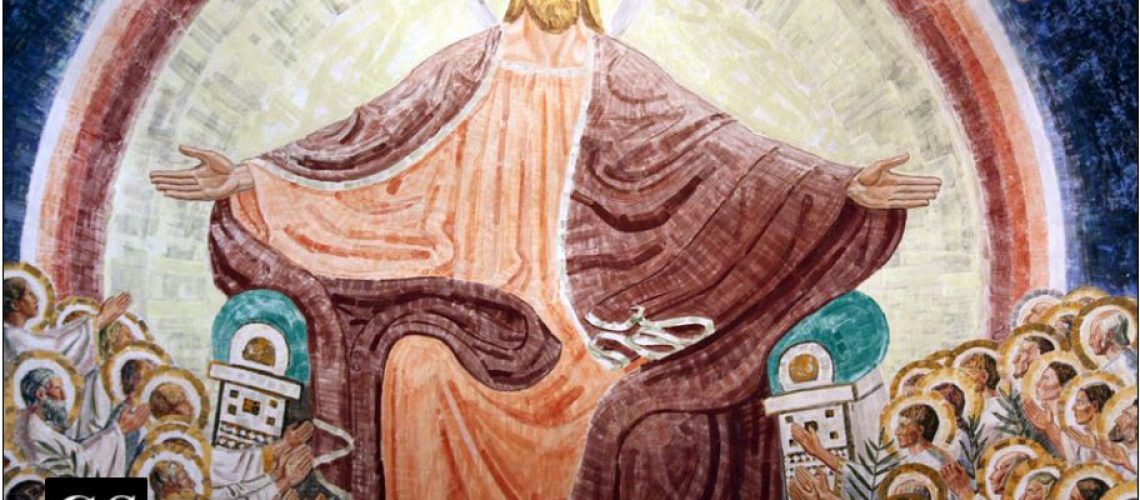
June’s “Unity Forum” in Augusta, GA, gathered leaders and lay people from many different Christian denominations to discuss the scandal of division within the Body of Christ and look with hope toward Christian unity. The forum was hosted by the charismatic, ecumenical Alleluia Community.
This year’s conference focused on the writings and life’s work of Fr. Peter Hocken (d.2017), British theologian and member of the Theology Commission of Catholic Charismatic Renewal. Author of more than 17 books on the Charismatic Renewal and the ecumenical movement, Fr. Hocken sought to understand the various outpourings of the Holy Spirit during the 20th Century.
As a member of Alleluia of nearly 20 years, I attended the conference as a participant. During the opening praise and worship session, the Lord gave me a parable. Perhaps I should say, He MADE me a parable. About a year ago, I pinched a nerve in my back after an unfortunate jiu-jitsu accident. My physician explained that the technical term for injuries obtained while trying to learn a combat sport at age 47 is “stupidity.”
For the past year, I’ve been limping around with pain shooting down my left leg from this pinched nerve. The outer toes on my left foot are partially numb, and my entire leg has a tendency to cramp from top to bottom. There was even a point when I was unable to run because my foot wouldn’t respond, though thankfully, that has resolved. It’s the worst pain I have ever experienced.
A Vision of the Body Suffering
This pinched nerve is an image for disunity in the body of Christ. I can’t always feel my toes, but they are still my toes. My leg is supposed to be strong, but it is weak. The communication between my leg and the rest of my body is constrained because of the pinched nerve, and the result is pain and dysfunction.
This parable in my body illustrates the reality of division within the body of Christ. As the Vatican II document Unitatis Redintegratio wrote, “Baptism, therefore, constitutes a sacramental bond of unity linking all who have been reborn by means of it.” Baptism is the means by which all Christians are brought into the Body of Christ. When there is disunity within the body, it’s like a pinched nerve cutting off communication and bringing suffering where there should be unity.
From this perspective, disunity within the Body of Christ is an illusion. God’s action in baptism brings Christians into Christ’s body, and our human disagreements and failings can’t separate what God has joined together. At the same time our disunity is all too real, and like a pinched nerve, can make trying to live together a lot more painful.
A Path Towards Rehabilitation
Two of the speakers shared perspectives that helped understand the way forward. Bishop Andrzej Siemieniewski of Legnica, Poland shared that the goal for ecumenism shouldn’t be a kind of lowest common denominator Christianity where we only focus on areas of agreement. This approach impoverishes us all. Instead, real ecumenism supports mutual enrichment, where we share the elements that are most precious and excellent in our spiritual experiences with one another. This kind of ecumenism produces a richer faith experience, while losing nothing essential.
Bob Garrett, the retired overall coordinator and long-time member of the Alleluia community, closed out the conference with a keen analysis of three levels at which ecumenism takes place.
The first level takes place within the hierarchical and institutional authorities of the churches. This is visible at the Vatican and their various official outreaches to different denominations. At the highest level of the Catholic Church, they’re seeking to foster inter-religious dialogue with the hope of rebuilding relationships that have been long broken.
The second level takes place in theological and academic discussions. Theologians from different denominations come together and wrestle with the theological disagreements that have been a source of division through the generations. It is difficult and painstaking work, because it requires that we cling to the Truth and seek understanding together.
One beautiful fruit of this kind of work is the Joint Declaration on the Doctrine of Justification that was published by the Catholic Church and the Lutheran World Federation, which said, “Together we confess: By grace alone, in faith in Christ’s saving work and not because of any merit on our part, we are accepted by God and receive the Holy Spirit, who renews our hearts while equipping and calling us to good works.” This declaration resolves one of the key points of division from the Protestant Reformation.
The third level of ecumenism is where the people in the pews can get involved. We’re not going to be able to make a formal agreement between denominations, because we don’t speak on behalf of church institutions. We can’t resolve the sticky theological questions, which we may not even understand. But we can love one another. The Alleluia Community, as the conference host, was a prophetic witness to this third layer of ecumenism.
Walking It Out
For over 50 years Alleluia has been living ecumenism practically by building a community of Christians from many different denominations. We feel called by God to try to live community the way the book of Acts describes it. We operate a school together where we educate our children. We’ve developed a neighborhood where the members live within a cup of sugar distance. We have learned to love, to embrace one another, and to carry the cross of not being in complete communion.
At the 1977 Charismatic Conference in Kansas City, Dr. Ralph Martin shared the prophetic word, “Come before me with tears and mourning for the body of my Son is broken.” The parable of the pinched nerve is poignant because there is a real and deep pain that comes from not being able to share some of the deepest truths of our faith with people we deeply love.
Yet the pain is a sign of a deeper unity that disagreements cannot destroy. As St. Augustine said, “Others are separated, insofar as they are joined with us in professing faith in Christ, our head, but are yet divided from the unity of his body. My friends, we must grieve over these as over our brothers; and they will only cease to be so when they no longer say ‘our Father’.”
Fr. Peter Hocken saw the Holy Spirit’s work in the Catholic Charismatic Renewal and other outpourings of the Holy Spirit across the world as an eschatological sign. The Holy Spirit is working to heal and restore these divisions in the Body of Christ that are so painful in preparation for our Lord’s return in glory. The Bride of Christ is not destined to limp along forever. The Bridegroom is coming. Maranatha! Come, Lord Jesus!
To read my story of how Jesus Christ snatched me from the snares of the devil, get my book Demoniac on Amazon.com. Subscribe to my Substack to get more of my articles directly into your inbox at nathankrupa.substack.com.

