
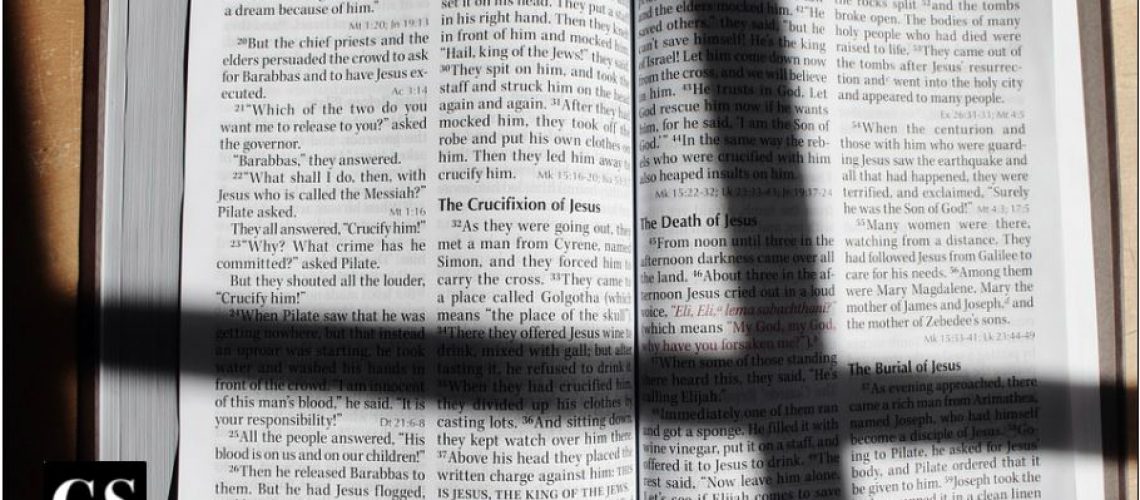
The parish men’s group I belong to always has lively and thought provoking discussions. If your parish has a men’s group you might consider joining. If it does not, consider starting one!
At our weekly meetings we discuss a random passage from such works as the Imitation of Christ by Thomas a Kempis or The Way by Jose Escrivá. We then try to link the passage to the upcoming mass readings. And, of course, we discuss the upcoming Sunday readings as well.
Our discussion methodology involves traditional bible study of the passages’ literal meaning and allegorical interpretations, followed by the implications of how we should live a Christian life. A key question is always what stands out in the readings. We then discuss what the passage means to each of us. We also offer up any personal experience that might relate to the reading.
The end result is lively discussions with differing interpretations and meanings expressed.
The Fog
At a recent discussion one of the guys commented on how the focus, intent, or meaning of some passages are not always clear or easily understood. It can be like getting a glimpse of the landscape in and out of a “fog.”
But consider that sacred scripture developed centuries ago, in another historical time, in another culture, and in another language. I think it’s a miracle we understand as much about scripture as we do.
What’s more, various passages have more than one theme or meaning. And it is often rewarding to analyze and discuss these meanings. One way we do this is by comparing our priest’s homilies on the same scripture passage over the years.
The Lens to See Through the Fog
A given scripture passage can have many levels of meaning. In turn, ones’ personal history and faith journey provide a lens to try to comprehend the message. That faith lens, however, is not always 20/20. More often than not, is too near sighted or far sighted. Consequently, to use the vision analogy, we have to squint or use another lens.
Going beyond our personal lens of interpretation can provide guideposts that can help us on the path of understanding to cut through the “fog.”
We can also use other lenses to help get a clearer understanding. History, the total biblical context, the Catechism of the Catholic Church, well respected writers (such as Thomas a Kempis) and numerous bible scholars are these other lenses.
A Fog by Design?
Another factor to consider is that God inspired sacred scripture. Since this is so, maybe some passages are unclear or vague for a reason.
Can the fog serve as a stimulus that challenges us to think and reflect? In other words, could it be that the intent may be that the written word does not always express the message in clear neon letters but instead, challenges us to dig out meaning on purpose? As a consequence, this forces us to stretch our “mental and spiritual muscles.”
In a sense, we can consider the spiritual massaging of scripture that we undertake a reflection of using our free will. And our free will affects our perceptions.
No Automatons
We might view our free will as a kind of personal AI that helps us understand. I believe God created us to journey, not just blindly follow a path to faith. So it can be in trying to fully understand scripture.
The point is that faith is a discovery process. It is a physical, mental, and spiritual journey. And studying scripture is just one avenue. Searching for meaning and insight in scripture or other faith writings is using our free will for our faith journey.
Any fog we experience in studying sacred scripture is, in the end, I think, a good thing. And while it often may leave us frustrated with unanswered questions, over time, with diligent study, I believe much of the fog gets lifted.
In turn, as mentioned, the discovery process stretches our mental and spiritual muscles. We become better able to comprehend the faith journey at all levels and to better comprehend God’s revelation to us.
A Fitness to Discern Gods’ Revelation
Our God is a “revealed” God. As such, what to believe and how to act on that belief are elements of that revelation. Life is complicated, consequently, the attempt to understand his revelation as it relates to our life requires an effort. His gift of free will enables us to go on a “quest” to discern that revelation. Gradually, through scripture and through living our lives we are able to lift the fog of understanding.
We can use our free will in the wrong way or we can use our free will to discover God and his plan. And that journey, as with any “quest,” can be full of surprises, twists and turns.
A physical journey requires physical fitness. This fitness enables us to endure whatever physical efforts we confront. Consequently we undergo physical training in preparation.
Likewise, for our faith journey spiritual fitness is necessary. Working through and attempting to see through whatever fog appears in Scripture can serve as our training regimen to develop the spiritual fitness for the total faith journey.
St. Paul, in his letter to the Ephesians 1:17, offers us words of wisdom that can help us grow in the needed spiritual fitness. We can turn these words into a prayer that will help us cut through any fogs we encounter in our faith journey.
God of our Lord Jesus Christ, the father of glory, give me a spirit of wisdom and revelation resulting in knowledge of You.

