
A Geopolitical Forecasting
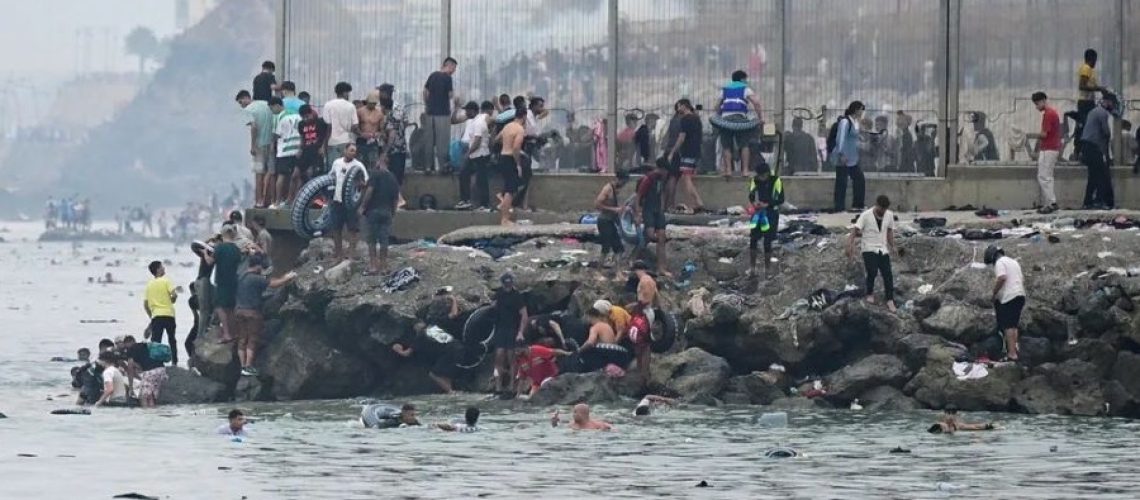
In a dramatic escalation that has thrust a centuries-old territorial dispute back into the international spotlight, nearly 60,000 migrants from Morocco surged across the border into the Spanish enclave of Ceuta over a single week [1], overwhelming the territory’s infrastructure and exposing the fragile geopolitical fault lines that run beneath the surface of Europe’s southern flank. For Catholics, however, the crisis cannot be viewed solely through the lenses of geopolitics, migration policy, or national sovereignty. It is also a profound human and moral crisis involving the dignity of people created in the image of God.
The Catholic Church has responded by calling for the protection of migrants and the vulnerable while urging authorities to pursue peace, stability, justice, and an orderly response to the emergency. Pope Leo XIV has expressed his concern for the situation in Ceuta, praying through the intercession of Our Lady of Africa that “solutions of peace, stability, and justice” may be found. At the same time, Catholic social teaching recognizes that governments have legitimate responsibilities to protect their borders, maintain public order, and safeguard the common good. The crisis, therefore, raises a difficult moral question: how can the dignity and legitimate needs of migrants be protected without permitting human desperation to become an instrument of geopolitical pressure? The crisis represents far more than a migration emergency.
For geopolitical analysts and regional observers, the crisis constitutes a sophisticated information operation, a calculated act of statecraft designed to pressure Spain and test the resolve of its left-leaning government amid a volatile international context shaped by war, diplomatic manoeuvring, and shifting alliances.
To fully comprehend the complexities of the Ceuta crisis, one must apply a structured analytical framework. By asking the ‘5WH’ questions, this analysis reasons through the actors involved and their alliances, identifies the underlying causes and effects, and forecasts the geopolitical trajectory of this simmering confrontation.
At the centre of the crisis are two sovereign states with deeply intertwined yet adversarial histories: Spain, a predominantly Catholic nation led by Prime Minister Pedro Sánchez, and Morocco, an Arab League member governed by King Mohammed VI through a conditional constitutional monarchy. The personal and ideological dimensions of this conflict cannot be overstated. Sánchez, a socialist leader, has cultivated an image of himself as a pro-immigration liberal and a vocal critic of President Donald Trump and Israeli Prime Minister Benjamin Netanyahu’s military campaign against Iran, a stance that has placed Spain at odds with powerful international actors. Sánchez’s government has refused to permit the United States to utilize Spanish military bases for operations related to the conflict in Iran, a decision that reportedly prompted Trump to threaten a trade war. “We’re going to cut off all trade with Spain. We don’t want anything to do with Spain,” Trump declared at a NATO summit in Ankara, ordering an immediate halt to all trade with the NATO ally [3].
Morocco, by contrast, has aligned itself with the United States and Israel through the Abraham Accords, the series of joint normalization agreements brokered by the Trump administration in 2020 [4]. The accords established official diplomatic, economic, and security ties between Israel and several Arab nations, including Morocco, the United Arab Emirates, and Bahrain. This alignment has positioned Morocco as a strategic partner of the United States and Israel, while Spain’s increasingly pro-Palestinian orientation and diplomatic rapprochement with Algeria have alienated both Washington and Jerusalem. Spain recognized the State of Palestine in May 2024 and has been among the European countries most critical of Israel’s military campaign in Gaza [5].
Complicating the picture further is the involvement of non-state actors and political factions. Spanish political commentator Carolina Alonso articulated a widely discussed conspiracy theory, writing on X, “It is a coordinated attack between Morocco, the United States, and Israel, with the collaboration of the European and Spanish far right, as retaliation for Prime Minister Pedro Sánchez’s trip to Algeria and, in passing, with the intention of annexing Ceuta and Melilla” [6]. Whether or not this represents an accurate assessment of official policy, it reflects the perception among certain segments of the Spanish left that the migrant surge is not a spontaneous humanitarian event but a calculated act of geopolitical warfare.
The immediate trigger for the current crisis was the arrival of more than 60,000 migrants into Ceuta over a single week, an unprecedented surge that overwhelmed the enclave’s resources and infrastructure. Ceuta, with a population of approximately 84,000 residents, was simply unprepared to process, house, or manage such a massive influx [1]. Juan Jesús Vivas, the head of Ceuta’s government, called the situation “a situation of absolute humanitarian and social emergency,” a characterization that reflects the acute pressure on the territory’s social services and border security apparatus. At least 67 migrants died trying to enter the city, with many drowning or being crushed while attempting to scale the breakwater that holds the border fence [1].
Geopolitical analysts have interpreted this surge not as a spontaneous migration event but as a deliberate act of social engineering by Moroccan authorities. By relaxing border controls and facilitating the movement of migrants into Ceuta, Morocco has effectively weaponized human mobility to exert pressure on Spain and draw international attention to its long-standing territorial claims over Ceuta and Melilla. This tactic, often referred to as “migration instrumentalization” or “hybrid warfare,” [7] [8] represents a cost-effective means of applying diplomatic and political pressure without resorting to kinetic operations or open military confrontation.
The timing of the crisis is deeply significant. It occurred on July 30, 2026, coinciding with the Fiesta del Trono, the celebration commemorating King Mohammed VI’s ascension to the throne, a date of profound national significance for Morocco. The king chose to celebrate the festivity in the prefecture of Rincón-Castillejos, a region bordering Ceuta, a decision that many observers interpreted as a pointed message to Madrid. The crisis occurs amid the ongoing Iran war and the diplomatic war between Spain and the United States and Israel. Spain’s refusal to support military operations against Iran, coupled with its recognition of Palestinian statehood, has placed Madrid in the crosshairs of the Trump administration and the Netanyahu government. The Ceuta crisis, therefore, must be understood as part of a broader geopolitical struggle in which Spain finds itself increasingly isolated from its traditional allies.
Geographically, Ceuta is a flashpoint for several reasons. It is much closer to Morocco than to mainland Spain, sharing a physical land border with Morocco and located directly on the North African mainland. This proximity makes it both strategically valuable and inherently vulnerable. Ceuta, along with Melilla, are the last remnants of Europe’s colonial presence in North Africa, territories that Spain has controlled for over 500 years [9]. For decades, Morocco has maintained its claim to these enclaves, practically since its independence in 1956, while Spain considers them an integral part of its national territory. Morocco does not recognise Spanish sovereignty over Ceuta and Melilla, referring to them instead as ‘occupied lands.’ [10] Both cities are part of the European Union and the Schengen Area, making them de facto European territories on the African continent, the EU’s only land borders with Africa, a geographical anomaly that has long been a source of diplomatic friction.
The “why” and “how” of the Ceuta crisis are rooted in the complex legacy of colonialism and the strategic use of information operations. Spain’s presence in Ceuta and Melilla dates back centuries, Ceuta was conquered by Portugal in 1415 and passed to Spanish control in 1580, while Melilla was conquered by the Crown of Castile in 1497 [11]. Critics argue that Spain has no moral authority to advocate for Palestinian independence or criticize Israel’s actions while maintaining what some perceive as colonial enclaves on the African continent [12].
The Israeli Ambassador to the United Nations, Danny Danon, seized on this contradiction, writing on X, “Spain, which never misses an opportunity to lecture Israel, has declared a state of emergency in Ceuta following the crisis over its immigration policy. Maybe before it continues lecturing us, it’s time it explained to the world why it still maintains colonial enclaves in Africa”. This statement, which Spanish Transportation Minister Óscar Puente Santiago responded to directly with the cryptic remark, “Well, things are starting to get pretty clear,” [5] encapsulates the rhetorical dimension of the conflict.
Information operations have been a critical component of the Ceuta crisis from its inception. Prime Minister Sánchez attributed the surge to migrant-trafficking networks that had purposefully misinterpreted a July Spanish Supreme Court ruling, believing it banned the immediate return of sea-arrival migrants without a trial [13]. The interpretation “spread like wildfire” on social media and messaging applications, creating a viral rumour that anyone who reached Ceuta by swimming could not be returned to Morocco [14]. Many of the migrants interviewed in news reports claimed they had been encouraged to undertake the journey by social media posts [15].
The narrative that Morocco’s actions are a form of retaliation for Sánchez’s trip to Algeria, the first in four years after relations ruptured in 2022 when Spain abandoned its long-standing neutrality on Western Sahara and backed Morocco’s sovereignty claim for the disputed territory, has been widely disseminated across social media platforms. This narrative serves to delegitimize Morocco’s actions as politically motivated rather than humanitarian, thereby shifting the burden of responsibility onto Rabat.
Conversely, Moroccan officials and their supporters have framed the migrant surge as a natural consequence of Europe’s failure to address the root causes of migration or engage with Morocco as an equal partner in managing regional security. By leveraging social media and state-affiliated media outlets, both sides have sought to shape international perceptions and influence the diplomatic calculus of third-party actors.
Looking ahead, several scenarios are plausible, each with significant implications for regional stability and international relations.
Scenario One: Escalation and Annexation – Morocco continues to escalate its pressure on Spain, potentially by facilitating further migrant surges or by threatening to annex Ceuta and Melilla outright. Spain, facing domestic political pressure and criticism from conservative opposition parties, responds by reinforcing its military presence in the enclaves and seeking support from European allies. The European Union is forced to take sides, straining its relationship with both Spain and Morocco. The United States and Israel, viewing Spain as an obstacle to their strategic objectives in the Middle East, support Morocco’s claims, leading to a diplomatic rupture between Madrid and Washington.
Scenario Two: Diplomatic Resolution – Alternatively, Spain may offer Morocco significant concessions, such as increased economic cooperation, enhanced border control assistance, or even recognition of Moroccan sovereignty over Western Sahara in exchange for Morocco ceasing its use of migration as a geopolitical weapon. This would represent a significant shift in Spanish foreign policy, aligning Madrid more closely with Rabat and potentially improving relations with the United States and Israel. However, such a move would likely provoke backlash from Spain’s left-wing coalition partners and exacerbate domestic political tensions.
Scenario Three: Stalemate and Protracted Tension – In this scenario, the Ceuta crisis settles into a pattern of low-intensity conflict, with periodic migrant surges and diplomatic skirmishes but no major escalation. Both sides maintain their positions, using the issue as a bargaining chip in broader negotiations. The enclaves remain Spanish, but tensions persist, creating instability in the Western Mediterranean and undermining EU border security.
In conclusion, the Ceuta crisis is a stark reminder that the battlefields of the 21st century are not confined to traditional military theatres. They extend into the realms of migration, information, and digital influence. Morocco’s use of migration as a geopolitical weapon represents a new frontier in hybrid warfare, one that exploits the vulnerabilities of European border security and the contradictions of post-colonial sovereignty.
For Spain, the crisis is a moment of reckoning. Prime Minister Sánchez must navigate a treacherous diplomatic landscape, balancing his government’s pro-Palestinian orientation with the need to maintain stable relations with Morocco and address domestic political pressure. Meanwhile, the international community must recognize that the Ceuta crisis is not merely a bilateral dispute but a microcosm of broader geopolitical tensions that will shape the future of Europe, the Middle East, and North Africa.
As the situation unfolds, one thing is clear: the enclaves of Ceuta and Melilla will remain flashpoints, their fate woven into the intricate fabric of international relations, migration politics, and the enduring legacies of empire.
___
References
[1]Israel critica ante la ONU la política migratoria de España tras la crisis en Ceuta [Israel criticizes Spain’s migration policy before the UN after the crisis in Ceuta]. (2026). Swissinfo. https://www.swissinfo.ch/spa/lo-que-se-sabe-de-la-entrada-masiva-de-migrantes-en-el-territorio-español-de-ceuta/91831525
[2]Barragán, C. (2026). After Tens of Thousands of Migrants Enter Spanish Territory, Most Return to Morocco. The New York Times. https://www.nytimes.com/live/2026/07/31/world/spain-ceuta-migrants-morocco
[3]Pamuk & Latona (2026). Trump orders halt to US trade with Spain over NATO spending, Iran. Reuters.https://www.reuters.com/world/trump-says-he-ordered-cutting-off-all-trade-with-spain-2026-07-08/?utm_source=braze&utm_medium=notifications&utm_campaign=2025_engagement
[4]The Abraham Accord. (2020). The Abraham Accord Declaration. https://www.state.gov/the-abraham-accords
[5]Fernandez, B. (2026). Is Spain being punished. Aljazeera. https://www.aljazeera.com/opinions/2026/8/1/is-spain-being-punished
[6]Israel’s UN envoy sparks Spain spat with accusation of ‘colonial enclaves’ in Africa. (2026). The Times of Israel.https://www.timesofisrael.com/israels-un-envoy-sparks-spain-spat-with-accusation-of-colonial-enclaves-in-africa/
[7]Fakhry et al. (2022). Hybrid CoE Working Paper 14: Migration instrumentalization: A taxonomy for an efficient response. European Centre of Excellence for Countering Hybrid Threats. https://www.hybridcoe.fi/publications/hybrid-coe-working-paper-14-migration-instrumentalization-a-taxonomy-for-an-efficient-response/
[8]Gönczi, R. (2023). Disinformation as a Tool of Hybrid Warfare at the Polish-Belarusian Border.” Warsaw Institute. https://warsawinstitute.org/disinformation-as-a-tool-of-hybtid-warfare-at-the-polish-belarusian-border/
[9]Spain’s North African enclaves. (2002). BBC News. http://news.bbc.co.uk/1/hi/world/europe/2131636.stm
[10]Giuffrida, A. (2026). Why is Ceuta a migration flashpoint and how were so many people able to cross from Morocco?The Guardian. https://www.theguardian.com/world/2026/jul/31/ceuta-spain-eu-border-africa
[11]Ceuta, Melilla Profile. (2023). BBC News. https://www.bbc.co.uk/news/world-africa-14114627
[12]Alvarez, J.L. (2026). If Sanchez Keeps Targeting Israel, Jerusalem Should Raise Spain’s Costs. Middle East Forum.https://www.meforum.org/mef-observer/if-sanchez-keeps-targeting-israel-jerusalem-should-raise-spains-costs?p=2
[13]Freutas, A. (2026). The Supreme Court ruling at the center of Spain’s Ceuta migrant crisis. CNN.https://edition.cnn.com/2026/08/01/europe/spain-morocco-migrants-intl?Date=20260801&Profile=CNN&utm_content=1785569902&utm_medium=social&utm_source=linkedin
[14]Eljechtimi et al. (2026). “The viral videos that inspired tens of thousands to swim to Spain’s Ceuta”. The Print. https://theprint.in/world/the-viral-videos-that-inspired-tens-of-thousands-to-swim-to-spains-ceuta/3005583/
[15]Bradford, C. (2026). Morocco blames Ceuta migration influx on social media, human trafficking. New York Post. https://nypost.com/2026/08/03/world-news/morocco-blames-ceuta-migration-influx-on-social-media-human-trafficking/

