
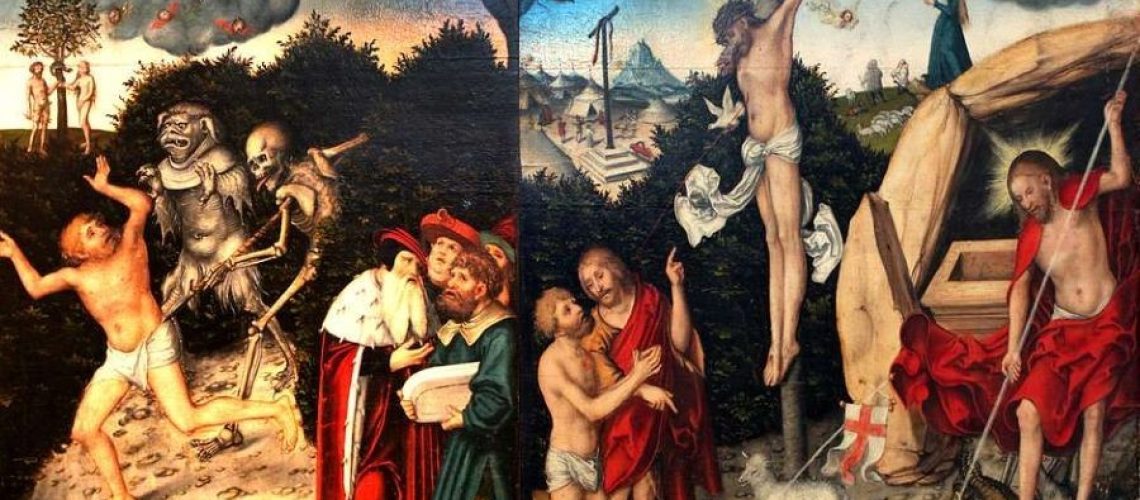
God revealed something to me and it is worth writing an article about. Personally, I find it to be a glimpse into the nuanced and divine acts of God the Father and Jesus. Due to the complex and subtly complicated character of this revelation, we need to keep things simple and basic, almost to the point that they might seem inadvertently banal and anti-climactic. The point here is not to produce a rhetorical sensation, no, it is to glorify the brilliance of God and Christ, and to really understand the sacrifice he made in order for us to navigate our current times. Not only that, but to also find salvation through these allegories, and why God, through Jesus, had to make them true and historical, make true stories into applicable allegories for our days, now, and our salvation from this world. Let’s explain.
First, what is an “allegory”? An allegory, in the most simple terms, is a story about one thing, one particular theme and characterization, that can be applied to reality. Maybe to explain or clarify, to compare and exemplify with more common materials. The famous allegory of the boy who cried wolf, for instance, is an allegorical story of how not to misuse people’s trust. The basic rhetorical structure of an allegory is usually said to contain a tenor, the underlying message, and a vehicle, the story that carries the message forth. It is not unusual that an allegory contains personifications of different abstract concepts, like death, justice, or salvation, then represented by actual people in the story.
However, the story of Jesus is not an allegory, nor is the story of God and life. Some say that the universe might be a simulation. That the universe and Creation, not unlike a quantum computer, is merely simulating what a Creation or universe could be. But that is not an allegory. An allegory still needs a reality that it is not, something it can reference and argue. This also shows that the historical life of Jesus, as God in the flesh, is in itself not an allegory; it is historical, and the stories in the Bible are widely agreed upon to be real and factual.
Here is where it gets interesting, and this is what was revealed to me, because even as real and historical as the events of Jesus might have been, they can still be applied today as allegorical messages concerning our secular, intellectual, sociological, conceptual, and cultural reality today – our world, collective and individual – and what is going on inside of it. This opens the door to a whole new depth of interpretation and application of the events of Christ in the Bible, a dimension too deep for a mere article, so we will simply remain on the theme itself, of allegory, and only look at one, albeit fundamental, example. Namely, the one where Jesus rises from the grave.
Among both atheistic and religious scholars of history, there is a consensus that Christ lived, was crucified, and buried in a cave-like grave from which he later rose. To the shallow intellectual, it might seem like a metaphor or allegory that references perhaps internal faculties in every person, perhaps some sort of conceptual scheme on how the inner workings of man actually work. And it might be so, too, but that it happened in actual human form, as people and social events, is remarkably proven. He lived it, Jesus. He died, was put in the grave, rose from the dead, and the boulder was removed. But what if it is also an allegory? With that in mind, let’s take a look at the perceptual ontology of materialism.
Materialism states that all that exists is matter and that reality is only matter bumping together, including brains that construct stories of identity and life to grab onto something. This means that every individual who has an idea of themselves or a perception of themselves, be it just about who they are or a reflection of their perceptual agency in general, would have to first bump into this fundamental substance in relation to somebody or something else. If we construct a dialectic scheme of the relational and meta-relational ontology of a social materialism, with a synthesis of a mind conceiving of itself, informing itself, by the knowledge it receives through other purely material things, then it would inevitably result in “nothing”. How?
Well, in simple terms: if all substances are matter and matter relates to things outside of itself, then the person interpreting herself as only matter or flesh would displace all of the stuff of substance in someone or something else. She would begin her subjective and dialectic walk outside of herself, in someone or something else. And this is through negation, since the concept of self begins with someone else and otherness. Which, in the dialectics of materialism, means that the perceptual subject must be synthesized as a complete and satisfied nothing, in relation to that which makes this subjective experience relevant, since all of substance – everything – has been placed in the other or the material thing, and that it happens through a meta-relation to oneself. In other words, in the epistemic flow or light that comes from this initiating material thing, via the meta-relational premise to oneself, there is something in the way – there is a boulder or a stone blocking the flow of light, the light of one’s participation with Creation and the things in it, one’s own personal Immanuel – the being-with God.
The epistemic nature of materialism is a negation of the Holy Spirit. When Mary, in Luke 1:34 – the literal episode of the Holy Spirit expressing its creative ethos – says, “how can this be, seeing I know not man?” she is basically saying, “how can I conceive of myself creating, when I haven’t epistemically related to the other according to materialism?” But when she conceives of herself, when she – through perception – gives birth to the woman that gives birth to Immanuel, she does not “not know a man” and negates his purely material form, his flesh. She, in other words, removes the relational boulder from the grave and becomes the birthing vehicle for the living God.
The grave of Christ can therefore be likened to the perceptual mind or consciousness, topologically with the skull or head. When we choose to adhere to materialism and the gathering of information via its epistemic premise, we then put a boulder between us and the thing we perceive. We have to, since matter alone can only know itself by interacting with things outside of itself, and negate the material existence of something or someone else. A mind that conceives of itself as only matter must negate itself from the other. It is as if things, then, become like inverted suns that don’t shine light but shine absence of light; as if we, instead of the function of the sun, put a boulder or stone in front of it when conceiving of our mind. It is as if our meta-relation constitutes whether or not we are in the grave, the grave into which Christ descended and rose from, due to the fact that we intellectualize reality through materialism and a negation of the Holy Spirit. Good news so far, since this also means we have the power to intellectually change the way we approach things, to again apply the Holy Spirit and remove the boulder. But what does this have to do with allegory?
Besides the more complex and sophisticated metaphysical mechanisms of perceptual self-relation, it is pretty straightforward: Christ lived out the story – the realism – of an allegory that can remain and act as a salvatory instruction and analogy for us all. His life was real and historical, yes, but through some divine influence much greater than our understanding, he managed to portray and live out an allegory for our time. God foresaw the allegorical use of Jesus’ life and fate. As God, then, we could even say he originated the allegory itself. Which is sort of the whole point with the ontological structure of the Trinity, of personhood: to create a space of possibility through contrast and relativity, to embody both the eternal and temporal, the infinite and mortal, the divine and human.
This, of course, leads to deeply profound speculations. Did Jesus know all along? Did he know that he was living out the inner mechanisms of individual salvation, in order for them to be recorded, documented, and written down as allegory? Is this the reason why he was so anxious, seeing he always knew that if he did this for us, if he took on the whole story himself for us to have now, in a world – in a temple and church – that that is constructed around the materialist negation of the Holy Spirit, he would have to suffer through the cost? It is almost like his life was that of a famous actor who knew that he would ruin his career, lose all contracts, and possibly put himself at risk if he played a part that had the instruction of salvation. Remember, Satan offered Christ the world. But the embodiment of that choice would have made the hermeneutic interpretation of allegory different. Not only that, but symbolically speaking, it would have constituted the emergence of the concept of allegory itself, possibly of any romantic, metaphoric, anaphoric, or tautological space at all, through the causal influence of Satan, not God. Ironically, without digressing too much, we see that Satan might want to replace the Holy Spirit and still use Christ to create ontological models.
The point we’re trying to make is the enablement of allegory by Christ, by – by divine influence – living in a pattern that explains internal mechanisms and how to be perceptually raised from the dead, to leave the grave with him. Because if the philosophy of hell is materialism, a world where one is only allowed collectively to look at the world through materialist eyes, then his descent into hell would be the carnal embodiment of the spiritual and mental faculties that cannot be told. In other words, Christ descended into hell by living out the allegory that can save us. Because that was the only form that was allowed. And he knew that historical life would remain as a story. And he probably knew and suffered through it all along.
It is almost like God knew he had to make salvation historical, into a person and a fate, and did so through Jesus, so that we could look at his life in two ways: both as undoubtedly historical, and also as an allegory for salvation. We are not only supposed to apply his personality, his sinless nature and character, to our respective lives, no, that is not the point of this revelation. Because anyone can live a sinless and Christlike life without being crucified and buried in a cave. The revelation in question was regarding the allegorical nature of his real life, and that he died and suffered to make this allegory available. To not use it, interpret it, and apply it to our modern-day intellectual reality would, if anything, be heterodox and a waste of Jesus’ suffering.

