
Passiontide: Humanity’s Dignity is Restored
Passiontide—covering the last two weeks of Lent from Passion Sunday (the Fifth Sunday) through Holy Week—is a season modern society would rather avoid. We prefer spirituality that is bright and inspiring, filled with takeaway messages, life hacks, and simple plans for abundance. What we avoid is confronting a bloodied man nailed to a Roman cross, crying out, “Eloi, Eloi, lema sabachthani?”
My God, my God, why have you forsaken me? (Mark 15:34).
Yet Passiontide forces upon us the great paradox that, in that utter humiliation, human dignity is not lost. It is, for the first time in history, restored. This is not the fragile dignity of status, wealth, or public approval (Ecclesiastes 1:2). Nor is it the performative dignity of a carefully curated reputation. It is the deep, unshakeable dignity of being loved beyond usefulness – of being worth saving even when we have made ourselves utterly unsaveable.
But God proves his love for us in that while we still were sinners Christ died for us (Romans 5:8).
If we have the courage to stand still and look, Passiontide offers a radical redefinition of what it means to be human. It declares that our worth is not measured by our competence, morality, or strength, but by the extent to which Love will go to retrieve us. And that extent, according to the Catholic faith, is infinite. It is all the way to a criminal’s cross (Luke 23:39-43) and all the way into the silence of a borrowed tomb (Matthew 27:57-61).
The Crisis of Modern Dignity
In our current cultural moment, we discuss dignity more than ever, yet we appear increasingly uncertain about what underpins it. The Catechism of the Catholic Church teaches that the dignity of the human person is rooted in his creation in the image and likeness of God (CCC 1700), yet modern society has largely severed that root. We are told that our dignity lies in our autonomy – the unfettered right to define ourselves. Yet the Catechism warns that the right to the exercise of freedom belongs to every man as a quality of his dignity, but only when ordered towards the true good (CCC 1747). Autonomy without truth becomes a crushing burden.
We are told that our dignity lies in productivity. Yet the Catholic tradition holds that human dignity is intrinsic, not earned. As Pope St. John Paul II wrote in Evangelium Vitae (1995), human dignity cannot be measured by criteria of usefulness or productivity (no. 12). What happens when illness, age, or depression strips you of productivity? A society that worships productivity discards its unproductive members. But the Church, following her Master, insists that the frail, the unborn, the dying, and the disabled possess full dignity precisely because they are loved by God.
Amid this crisis of exhausted self-justification, Passiontide speaks a scandalous word from the prophet Isaiah: “He was pierced for our transgressions, crushed for our iniquities… and by his wounds we are healed” (Isaiah 53:5). You do not have to earn your dignity, because it has already been purchased for you at a price so high that only God could afford it.
The Scandal of The Cross
To modern ears, this sounds like religious sentimentality. But the original hearers of the Gospel found it not sentimental but shocking. The Roman cross was a machine of state terror, designed to strip its victim of every last shred of human dignity: naked, exposed, tortured, and displayed as a warning. The Roman world regarded dignity as the property of citizens, free men, and the powerful. A crucified slave or rebel had no dignity. That was precisely the point.
Yet St. Paul declares, “I have been crucified with Christ; and it is no longer I who live, but Christ who lives in me” (Galatians 2:19-20). The Catechism explains that “By his death, Christ liberates us from sin” and “by His Resurrection, He opens for us the way to a new life” (CCC 654). More than that, on the cross, Christ identifies with the lowest, the most humiliated, and the most forgotten. As the Catechism states, “Christ died for all” (CCC 605, cf. 2 Corinthians 5:15), not for the worthy. For all.
The Church Fathers saw this clearly. St. Athanasius of Alexandria, in his masterwork On the Incarnation, wrote:
The Word was not confined to his body, nor was he present in the body only, but he was also in the world and in the universe… He who is invisible became visible, and he who is impassable became passable, enduring all things for us.
In other words, God’s dignity was not diminished by taking on flesh and suffering; rather, human flesh was elevated by God’s presence within it.
St. Leo the Great, in his Tome, preached: “The lowliness of the flesh is the glory of the divinity.” This is the Passiontide reversal: what the world calls weakness is, in Christ, the very vehicle of salvation. The Catechism echoes this: “By his glorious cross, Christ has won salvation for all men” (CCC 605).
The Veiled Altar and the Hidden God
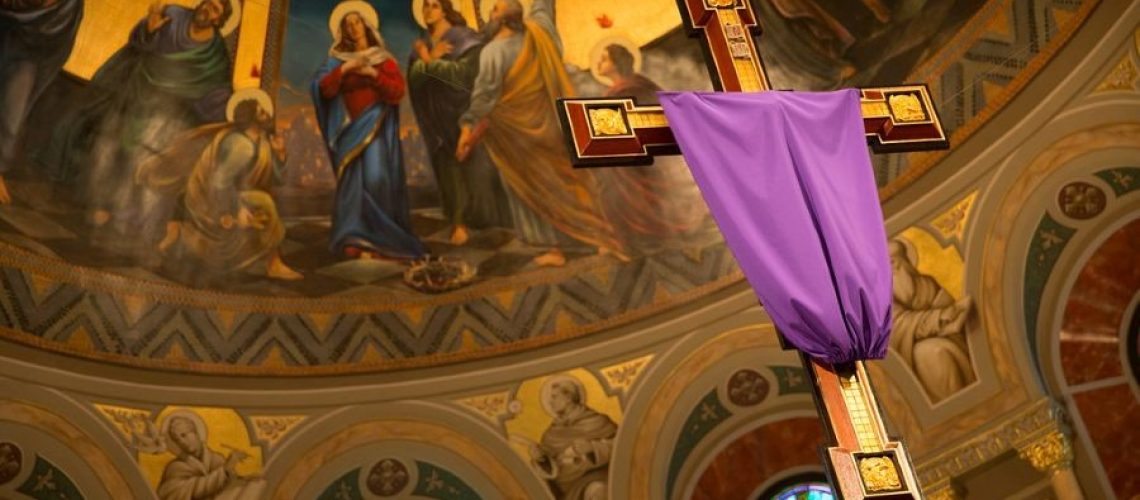
Perhaps the most distinctive feature of Passiontide in the traditional Roman Rite is the veiling of crosses and statues from Passion Sunday onwards. The purple cloths drape the crucifix, the statues of saints, and the images of glory. Why? The Church, in her ancient wisdom, teaches us through ritual. For two weeks, we are denied the visual comfort of our sacred images. We are made to feel the absence, the hiddenness, and the silence of God.
This practice echoes the Lord Jesus’s words, “A little while, and you will no longer see me, and again a little while, and you will see me” (John 16:16). The veiling is a ritual enactment of that brief period of abandonment. It prepares us for the ultimate hiddenness of Good Friday, when the Eucharist is not celebrated, the altar is stripped bare, and the tabernacle stands empty.
But here is the astonishing claim of Passiontide: even in that hiddenness, even in that silence, human dignity is not lost. Because the hidden God is the same God who, in the Improperia (the “Reproaches”) sung on Good Friday, addresses humanity as a betrayed lover:
My people, what have I done to you? How have I offended you? Answer me! (Micah 6:3–4)
The reproaches are not an expression of divine anger but of divine vulnerability. God, the Almighty, stands before His creatures and asks, “Why have you abandoned me?” In doing so, He enters the deepest human experience of rejection and shows that even there, dignity endures.
The Restoration of the Thief
No figure in Passiontide better illustrates the restoration of human dignity than the good thief, traditionally named Dismas. Crucified beside Jesus, he first mocks Him (Matthew 27:44), but then undergoes a stunning conversion. He rebukes the other criminal: “Do you not fear God, since you are under the same sentence of condemnation? And we indeed have been condemned justly, for we are getting what we deserve for our deeds, but this man has done nothing wrong.” He then turns and says, “Jesus, remember me when you come into your kingdom.” (Luke 23:40-42). The thief has no baptism, no sacraments in the ordinary sense, no good works to offer. He has only his desperate, last-minute plea. And what does Jesus say?
Truly I tell you, today you will be with me in Paradise (Luke 23:43).
The Catechism comments on this extraordinary moment: “By his death, Christ has conquered death and opened the gates of eternal life to all who believe in Him” (CCC 1020). But more specifically, the tradition has seen the thief as the model of the baptism of desire. St. Thomas Aquinas, in the Summa Theologiae (III, q. 66, a. 11), argues that the thief was saved not by the sacrament of baptism in water but by the sacrament of desire – his explicit faith in Christ and his act of repentance.
This means that, by his own admission, the thief’s entire adult life was one of crime and punishment. By every standard of Roman society, and even of religious law, he had forfeited his dignity. Yet in a few minutes, on a cross, gasping for air, he is restored to paradise. Not after years of rehabilitation. Not after earning back his worth. Simply by turning his face towards the crucified King and asking to be remembered.
Passiontide declares that no human life is too broken, no history too shameful, no death too ignominious to be reached by divine mercy. As the Catechism proclaims that “There is no sin, however grave, that the Church cannot forgive” (CCC 982), because Christ died for our sins (CCC 602). The thief is the icon of restored dignity: from criminal to citizen of heaven in a single breath.
The Silence of Holy Saturday and the Waiting Church
Passiontide does not end on Good Friday. It holds its breath through Holy Saturday, the most mysterious day of the year. The liturgy gives us almost nothing: no Mass, no Eucharist, no words. The altar stands bare. The tabernacle is open and empty. In the traditional office, the Church meditates on Christ’s descent into hell (the descensus ad inferos), that “He went and made a proclamation to the spirits in prison” (1 Peter 3:19).
The Catechism explains that “By the expression ‘He descended into hell,’ the Creed confesses that Jesus did really die and through his death for us conquered death and the devil who ‘has the power of death’ (Hebrews 2:14)” (CCC 636). And also, that “The descent into hell brings the Gospel of salvation to complete the proclamation of salvation to the dead” (CCC 634).
This is the ultimate extension of human dignity. Christ does not abandon those who died before His coming. He goes to the abode of the dead – the Sheol of the Old Testament – and opens its gates. No soul, however ancient or forgotten, is outside the reach of His love. As St. Ephrem the Syrian wrote in a homily on the descent: “He went down to the place of darkness and took the captives by force. He plundered the storehouse of death and gave life to all.”
Passiontide teaches us that human dignity is not bound by time, geography, moral performance, or even death itself. If Christ descended into hell to preach, then no human being is beyond redemption. That is the radical hope of the season.
Conclusion: The Dignity We Cannot Lose
We live in an age of anxiety about worth. Young people wonder whether they matter. The elderly wonder whether they are seen. The poor wonder whether they count. The dying wonder whether anyone will remember them. Passiontide answers with a crucifix.
The Catechism opens its section on human dignity with these words:
The dignity of the human person is manifested in all its radiance when the person considers his origin and his destiny (CCC 1701).
Our origin is God, who created us in His image (Genesis 1:26). Our destiny is God, who became man, suffered, died, and rose to bring us to eternal life. In between, we may fail, fall, or be humiliated by others or by our own sins. Yet Passiontide insists that none of that erases the image.
St. Augustine of Hippo, in his Confessions, famously wrote: “You have made us for yourself, O Lord, and our heart is restless until it rests in you.” That restlessness is the echo of our lost dignity seeking its home. And on the cross, the home comes to us. Jesus, the Second Adam, restores what the first Adam shattered (Romans 5:12-21). In his wounds, our wounds are healed. In his humiliation, our dignity is raised.
Take-Home Message
The Exsultet soon declares, “O happy fault, O necessary sin of Adam, which gained for us so great a Redeemer!” (O felix culpa). Passiontide does not deny human brokenness. It names it, suffers through it, and then shows us a God who refuses to abandon us to it. So let the crosses be veiled. Let the altar be stripped. Let the silence descend. For on the third day, the veil will be torn (Matthew 27:51), the stone will be rolled away (Mark 16:4), and the dignity of every human face – the thief’s, the sinner’s, the doubter’s, yours and mine – will shine forth in the Resurrection. This is the promise of Passiontide, and it is enough.
*NB: Unless specifically stated, all Bible quotations are from the NRSVCE.


[…] Read Dignity Restored, Glory Transfigured Part I: Passiontide: Humanity’s Dignity is Restored Part Dignity Restored, Glory Transfigured II: Easter Octave: Wounded Glory That Heals the World […]
[…] – Leaf Arbuthnot at The TelegraphIs This the Real Foot of Mary Magdalene? – Rome ReportsDignity Restored, Glory Transfigured: Part I & Part II – P. Mandela at Catholic Stand MagazineThis Irish Priest Jokingly Prayed for […]