
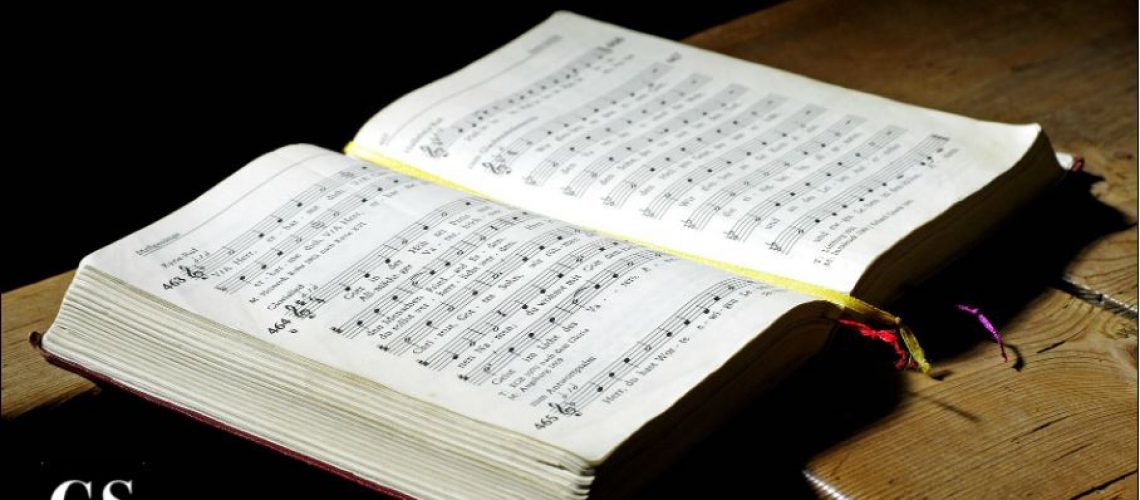
When Philip Fournier sat across from me for his interview, I almost didn’t know where to begin. His curriculum vitae has been published in the parish bulletin: extensive education, awards, an abundance of praise. It sounds very impressive. And, having sat, Sunday after Sunday beneath the choir loft at St. Rose of Lima Church in rural Maine, listening to the chant produced by Philip and his choir – the amazement in my mind is that a musician of his caliber is part of my own community.
Philip is one of the hiddenest of gems – tucked so carefully into the small towns of a rural diocese that he is easily missed. Visitors to Maine drive right by St. Rose, on their way up to ski at Saddleback Mountain or canoe down the Dead River. They might visit the Basilica in Lewiston or the Cathedral in Portland and think – “if there is great music in Maine, it will be here” – and then miss the beauty that Philip creates in his little choir loft, across from a ruined mill, along the river in Jay.
Negative Capability
John Keats wrote of a “negative capability” that the great poets possess – to “be capable of being in uncertainties, Mysteries, doubts … without any irritable reaching after fact and reason.” It is in this that the artist’s “sense of Beauty overcomes every other consideration, or rather obliterates all consideration.”
It is this negative capability that poured out of Philip Fournier during our rambling, conversational interview. He is an artist immersed in mysteries, in doubts, and especially in Beauty. He’s an Advent artist – a man whose creativity thrives in the thick, dark world of midwinter. His faith life centers around that midnight world – when flowers bloom in the snow and animals sing out the praises of Christ-Born-Anew. At Mass, we hear that anticipatory darkness in his chant – and many pieces written by Philip himself – and we, the faithful of all ages, are able to sink into it and feel the worship vibrate within us.
“My role is to spread as much darkness as possible,” says Philip, “I don’t believe that the innocuous has a place in the Mass.” He goes on to explain that “darkness, candles, and shadows” touch our souls in a way that “sterile, modern light” doesn’t. His words echo something I’ve long felt. Since moving off-grid, I’ve learned so much about the richness of night.
My life is lit by flickering candles and oil lamps. When night falls – and it falls so early in the winter – the light of each candle brings out the shadows in new and different ways. Christ is the light of the world, but can we see Him in a world flooded with stark, blue bulbs? He is a warm candle, or an oil lamp – wick trimmed neatly. His light is bright and welcoming, not harsh and cold. The imagery of light and dark in the Bible is hard to relate to until you become “acquainted with the night” – then you begin to notice Christ, the Light of the World, shining in the darkness beside you. “But,” Philip asks, “is it possible for a church hobbled by legal liability ever to know the night?”
St. Gregory of Nyssa wrote that Moses “found God in the Darkness.” In his Life of Moses, Gregory describes that friendship between Moses and God as one that develops from light to “luminous darkness.” The closer Moses comes to God, “when Moses rose higher and became more perfect, he saw God in the darkness.” Philip is like Moses in that way – his heart is eternally out under the stars. And like Moses, the God he meets in darkness becomes, for those who hear his music, a glowing, warming light.
Like Moses, he has an intense need to convey what he’s seen. In his music, and in his writing, Philip brings to life his image of a dark, medieval faith – earthier than our modern Catholicism, with deep shadows on the walls. Soft, yellow firelight and solemn Catholics playing with the mysteries entrusted to them. “The Medieval Church was a Christmas Church,” he says. “It was dark and dirty and playful, and young. But the post-Vatican II Church is an Easter Church – artificially triumphalist, like a corporate productivity strategy.”
His music hearkens back to the mysteries of the Medieval Church, but he’s not pretending to be anything but a 21st century artist. “No artist can escape being somewhat reactionary,” he tells me with a shrug. His own reaction was against the “soft, cushy” churches of his childhood and the church music of the 1980s and ’90s that left him “revolted” before he discovered the “distant beauty of chant.”
To Echo the Inexpressible
We’d been talking in a rambling way for over an hour when I asked him what his definition of an Artist was. “Artists are afflicted,” he replied, “by a dysfunctional compulsion to echo in a medium, the inexpressible in Creation as expressed by the Creator himself. Which means,” he added, “that disappointment is built into the attempt and experienced by the artist as failure.”
“Things don’t come out as they should.”
His definition focuses on the need to create. The “compulsion to echo … the inexpressible in creation.” It reminded me of the poet, Rilke’s advice to a young writer to “go within … find the impetus that bids you to write. … Does it stretch out its roots in the deepest place of your heart? … And if it should ring its assent, … then build your life upon it. It has become your necessity.”
It is clearly Philip’s necessity. His life is full of this compulsion to create. Whether he’s writing fiction, chant, or music that defies definition; at home with his family, at Mass, alone writing in his loft or practicing in the quiet of an empty church, with just Christ to hear him, Philip is constantly attempting to capture the inexpressible in Creation. More than any artist I’ve ever met, he embodies the romantic image of the haunted artist: “who hides anguish deep in his heart, but whose lips are so formed that when the sigh and cry pass through them, it sounds like lovely music” (Søren Kierkegaard).


[…] – TACatholicPrince William, the Crown, & the Crisis of Defensor Fidei – NuntiatoriaBeauty in the Darkness: A Conversation with Philip Fournier – M. Goepel at Catholic Stand MagazPortugal Pro-Life March Attacked – Filipe […]
Beautiful. Leo Sowerby is such a composer – holy, dark, sour, so in touch with his Savior.
If you want a compatible suggestion to what you hear in Mr. Fournier’s composition, get a copy of Medieval Poem arr. for organ 4 hands, tubular bells and voice.