
Anthony J. Yanik MA
When Charles died his staunchly Catholic brother succeeded him but to reign only three years. Parliament, fearing he might try to turn England Catholic, forced him to flee to France and invited the Protestants William and Mary to take the throne. In a magnanimous gesture, William instructed the colonies to tolerate all non-members of the Church of England — except Catholics.
The onset of the French and Indian War on Virginia’s frontier brought an increase in Anti-Catholic animus inspired by fears that Virginia’s Catholics might rise up and come to the aid of French Canada. Those fears led to the passage of an Anti-Catholic law in 1756 that required all Papists or suspected Papists to take the English oaths of allegiance and supremacy. And if the authorities suspected they might be harboring guns and ammunition they had the right to search the premises and imprison them if any were found. However, no instances of any such infractions were ever recorded.
Carolina came into existence as a proprietary colony a half century after the founding of Virginia. It was a reward to eight noblemen for providing financial aid to Charles II after the monarchy was restored. Its charter did not have the usual requirements contained in a royal colony. Being Proprietary it gave the eight the right to provide religious freedom to everyone who did not profess the Anglican religion as an attraction to increase the colony’s settlement. Catholics were free to come and go as they pleased. But whether Catholic or Protestant, not many settlers rushed in to take advantage of such freedom. Settlements were too distant from each other for good management. Out of necessity, the proprietors divided Carolina into two regions, North Carolina and South Carolina, each with its own government.
The division was not beneficial to North Carolina as it did not bring a decent return on the proprietors’ investment. From a religious standpoint, it also violated the original Carolina charter by taking religious freedom away from its Catholic settlers. Its lack of growth led its proprietors to sell their shares to King George II in 1712. The king then decreed North Carolina to be a crown colony for better management which brought the Church of England into the picture as its state supported religion.
South Carolina was better managed and realized commercial success through Charleston, the best seaport along lower British America’s coast and the region’s most important trade hub. It continued to offer religious freedom to all incoming settlers until 1697 when its assembly changed the original Carolina charter. It continued to allow Protestants to freely worship their religion but closed off that right to Catholics. Seven years later it additionally ruled that anyone seeking public office had first to take an oath certifying that he was a member of the Church of England and receive the “Lord’s Supper” in accordance with the practice of the Anglican Church. Such legal persecution continued to impact South Carolina’s Catholics. In 1741, for example, persecution continued when the colony passed a new act exempting everyone except Catholics from paying the Provincial taxes on their land. In 1759 a new election law closed full citizenship to all Catholics. It was open only to “free white men” who professed the Protestant religion.
Georgia, the last of the thirteen original British colonies founded, did not deviate from such anti-Catholic practices. Its charter as issued by King George II, in 1732, permitted religious freedom to all Protestants living in the colony except Roman Catholics. They were excluded from the right to vote and were forced to pay taxes for the support of the Anglican Church.
The charter placed the administration of Georgia in the hands of a council of trustees who could not agree on who should be its governor. Finally James Oglethorpe, one of the trustees, voluntarily stepped in over the first 15 months of Georgia’s existence to provide it with some semblance of leadership. He and was the only trustee to cross the ocean and live in the raw new land.
For almost 20 years the colony struggled to hold its own maintained by an annual subsidy from England. With no progress taking place in Georgia’s economic growth, English Parliament terminated the subsidy in 1751. Having no other source of income to keep the colony alive, the trustees surrendered its charter to the king who declared Georgia to be a crown colony with a new assembly which immediately declared Anglicanism to be the official state religion.
This change meant little to the settlers living on the colony’s western frontier. They were located so far from formal religious services that they were largely unchurched and probably never saw a Catholic within their lifetime. This mattered little since the colonies were going through a stage of religious turmoil brought on by those who advocated complete freedom of conscience or through a structure free of state interference. Delegates to the first Constitutional Congress in 1787 dodged the issue by making no mention of religion in the proposed first constitution except to ban religious tests for public offices. It would up to the states to define religious freedom within their communities.
When the newly formed Congress recommended that each colony draft a new constitution to replace the English document then in force, one of the major challenges they faced had to do with religious freedom. Should a colony continue to maintain its state sponsored Protestant religion that had effectively refused citizenship to Catholics in the past, or refused them to hold public office unless they first took a religious test oath to qualify? The new state constitutions that later did emerge varied from colony to colony with regard to religious freedom. Several still reflected their biases toward Catholicism
The New England Colonies had the most difficulty in making the transition. Massachusetts, Connecticut and New Hampshire had rigidly maintained a Puritan/Congregationalist state religion for generations. Should they depart from this practice? Massachusetts, after much debate, grudgingly agreed on wording acceptable to its electorate. Although it finally granted religious freedom to all, it could not bring itself to provide similar freedom to those aspiring for state office. For those who attempted to get their names on the ballot they first had to swear an oath that they believed in the Christian religion.
New Hampshire had an equally difficult time breaking with its past religious requirements. It took eight years before it agreed on a final draft that guaranteed everyone the right to worship God according to their own conscience. Noticeably absent was any mention of freedom of religion. Anyone seeking to compete for a seat in the House of Representatives had to first prove he was a Protestant.
Not until 1818 did Connecticut agree to a new constitution that provided freedom of religion to all Christians. Until then it continued to be governed by its original royal charter issued in 1662, which acknowledged only one faith: Congregationalism. The new document, when issued, did allow each congregation to collect taxes for its religious needs since the state no longer would supply such financial support.
Of the four Northern colonies, Rhode Island, although Puritan, continued to permit freedom of religion to its citizens. Not until 76 years had passed did Rhode Island finally write its first state constitution. It guaranteed freedom of worship to all, according to the dictates of their own conscience. It also granted landowners freedom to seek public office.
Although the Northern colonies finally overcame their longstanding prejudices against Catholics by granting them religious freedom, they could not put aside their fear of allowing them to participate in state government. That would come later.
The Middle Colonies (New York, New Jersey, Delaware and Pennsylvania) made freedom of worship a significant factor in their new state constitutions. New York did include one exception: to deny citizenship to incoming Catholics who were not born in the United States unless they took an oath of allegiance to the state of New York and renounced allegiance to the head of any foreign power, including the Pope. New Jersey declared that only Protestants were eligible to run for public office. Delaware denied Catholics that same eligibility unless they took an anti-Catholic test oath. Pennsylvania stood alone among the other Middle Colonies. It allowed Catholics to seek elected positions as long as they believed in God and in the divine words of Scripture.
For the most part, the Southern Colonies provided religious freedom in their constitutions. The exception was South Carolina. It continued to maintain Anglicanism as its state sponsored religion. It tolerated those settlers who believed in other faiths, except that they would not receive the civic and religious benefits of the state.
The question as to whether Southern Colony Catholics could hold state office was affirmed only in Maryland. Even then Marylanders had to promise to support the state constitution in order to qualify. In Virginia, North Carolina, South Carolina and Georgia only Protestants were eligible to run.
Virginia finalized its state constitution only after several years of debate. Its state constitution was so well crafted with regard to religious liberty (thanks to the efforts of Jefferson and Madison) that it later became the template on which the U.S. Constitution was modeled.
In the final analysis, more than a half century would pass before all 13 original colonies formally adopted state constitutions that met the religious freedoms promised in the Bill of Rights.
The Catholic population itself grew at an exceedingly slow rate following the American Revolution. Until the mid-nineteenth century, Catholics did not pose any perceived threat to the heavily Protestant regions. Catholic increases in numbers during the early post-colonial society was at a standstill. None was expected. When the diocese of Charlestown was created in 1820 it encompassed all of Georgia, North and South Carolina, and yet only counted 400 members.
New England was exceedingly slow in admitting Catholics. By 1808, only 100 Catholics were known to live in New Hampshire. Not until the 1820s when cheap manual labor was needed to work in that states’ newly created industries was there a Catholic growth of any consequence.
The Middle States with their valuable port cities were the entry points through which the bulk of poor Irish Catholic immigrants passed and made a Catholic presence more visible. The first Catholic Church in New York City was St. Peters, dedicated in 1786. It was here that St. Elizabeth Seton was received into the Catholic Church in 1805. Pennsylvania with more liberal views on religion was where most incoming Catholics gravitated. As early as 1790 there were about 7,000 Catholics living in the state, a third in Philadelphia.
As the number of Catholics grew, so did negative reactions from Protestants concerned about losing their jobs to the immigrant Irish Catholics. Protestant ministers had no qualms about preying on their congregations’ fears from the pulpit. Their vocal efforts paralleled a rise in anti-Catholic propaganda in newspapers, magazines and books, which were, at times, quite lurid in their attacks. The most famous was the fraudulent “Awful Disclosures of the Hotel Dieu Nunnery in Montreal,” allegedly authored by Maria Monk. It was later refuted not only by Catholics but by Protestants as well.
Such propaganda unfortunately prompted riots between Catholics and Protestants. The Ursuline convent in Charlestown, Massachusetts, for example, was burned down in 1834 after a series of anti-Catholic sermons delivered by the Presbyterian minister Lyman Beecher. In May 1844 two Catholic churches were burned in Philadelphia. Later that summer 20 people died and 100 were injured when riots broke out in Philadelphia.
No one, however, was prepared to expect the repercussions of the Great Potato Famine that began in Ireland in 1845. Desperate for work to feed and clothe their families, Irish Catholics fled their country in droves, flooding the cities and countryside of the Eastern seaboard. As many as 1,250,000 starving Irish Catholics entered the United States between 1845 and 1855. Their numbers overwhelmed the northern and middle states.
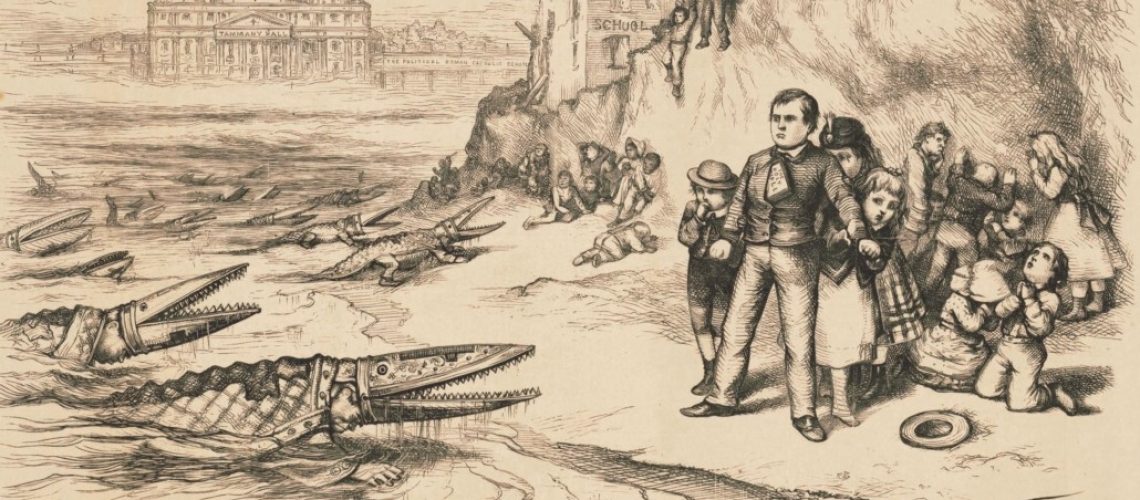
The Protestant reaction was not long in coming. It gave way to the forming of anti-Catholic secret societies. By 1852 they merged into the Know Nothing Party whose members vowed to say “I know nothing” if ever questioned about their allegiance. Their political platform was to advocate a 21-year wait for anyone desiring citizenship in the United States. The Party had some political success until the Civil War when its members fought each other over the question of slaver
Over time, Irish Catholic immigrants assimilated into American society, and public attitudes toward them gradually changed. European Catholics became more encouraged to settle in a land where anti-Catholic persecution, which for so many years been an accepted legal and social norm, slowly decreased over time.
SOURCES CONSULTED
- Father Charles P. Connor STL, P.H.D., Pioneer Priests and Makeshift Altars (Ironside, EWTN Publishing, 2017);
- James Commint, ed., An Encyclopedia of Social, Political, Cultural and Economic History (Armonk, New York, M. E. Sharpe, Inc., 2006);
- Kenneth Coleman, Colonial Georgia: A History (New York, Charles Scribner’s Sons, 1976); Robert Emmett Curran, Papist Devils: Catholicism in British America (Washington, D. C., The Catholic University Press, 2014);
- Francis X. Curran, Catholics in Colonial Law (Chicago, Loyola University Press, 1963); Stanley Cutler, ed., Dictionary of American History (Detroit, Charles Scribner’s Sons, 2003);
- John Tracey Ellis, ed., Documents of American Catholic History, vol. 1 (Wilmington, Michael Glazer, 1987);
- John Mack Farragher, ed., The American Heritage Encyclopedia of American History (New Haven Holt and Company, 1998;
- Thomas Fleming, New Jersey: A “Bicentennial History (New York, W. W. Norton & Company, Inc., 1978);
- Michael V. Gannon, Florida: A Short History (Gainsville, University Press of Florida, 2003);
- Michael V. Gannon, The Cross in the Sand: The Early Catholic Church in Florida, 1513-1870 (Gainsville, University Press of Florida, 1963);
- Michael Kamman, Colonial New York: A History (Detroit, Charles Scribner’s Sons, 1975);
- Philip A. Klein and Ari Hoogenboom, A History of Pennsylvania (University Park, Pennsylvania University Press, 2003);
- Stanley I. Kutler, Ed. In Chief, Dictionary of American History (Detroit, Charles Scribner’s Sons, 2003);
- Frank Lambert, The Founding Fathers and the Place of Religion in America (Princeton, Princeton University Press, 2003);
- Hugh T. Lefler & William S. Powell, Carolina North Carolina – A History (New York, Charles Scribner’s Sons, 1973);
- Bernard L. Marthaler, ed., New Catholic Encyclopedia, vols 1-7, 9, 11 (Washington, D.C., 2003);
- Thomas T. McAvoy, A History of the Catholic Church in the United States (London, Notre Dame, 1969);
- William G. McLoughlin, Rhode Island, A Bicentennial History (New York, W. W. Norton Company, Inc., 1978);
- Elizabeth Forbes Morison and Elting Morison, New Hampshire (New York, W. W. Norton & Company, 1976);
- D. Powell, North Carolina: A History, (New York,, W. W. Norton & Company, Inc., 1977);
- Thomas P. Slaughter, The Tangled Roots of the American Revolution (New York, Hill and Wang, 1978);
- Peter Jesserer Smith, U. S. Martyrs Sow Seeds of Faith (Irondale, National Catholic Register; August 6-19, 2017);
- Robert J. Taylor, Colonial Connecticit, A History (Millwood Kto Press, 1972);
- Louis B. Wright, South Carolina: A Bicentennial History (New York, W. W. Norton & Company, Inc., 1976).

