
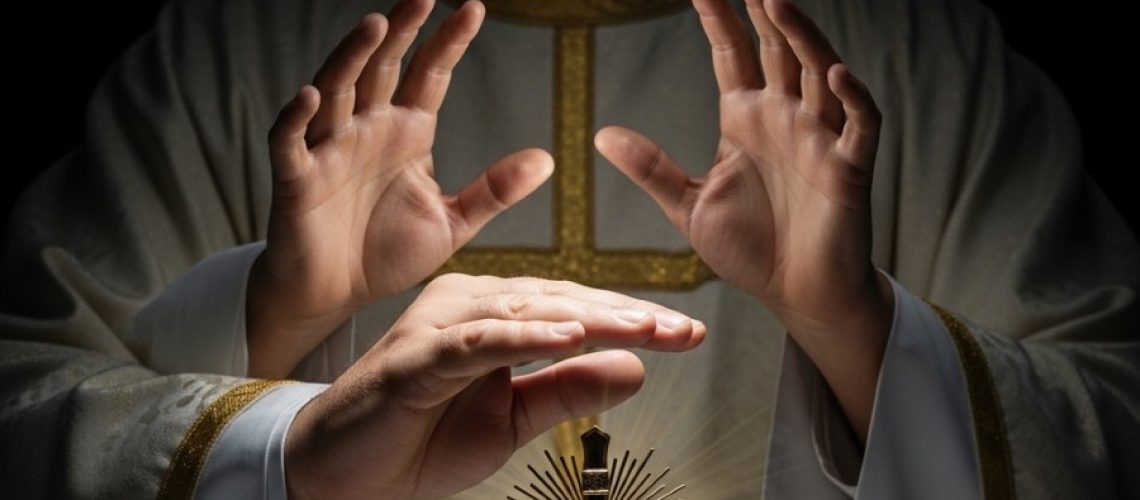
When Jesus ascended into Heaven, He did not abandon us. Jesus remains here with us in His Church where he continues to guide and heal us. One of the several ways Jesus dwells with us here on earth is in the Eucharist at the Most Holy Sacrament of the Altar.
In the celebration of the Eucharist, bread and wine become the Body and Blood of Jesus Christ through the power of the Holy Spirit and the instrumentality of the priest (USCCB).
The body, blood, soul and divinity is wholly present in the Eucharist after consecration. In order to have eternal life in Him, we must “eat of His flesh and drink of His Blood”.
At first, it may be difficult for the human mind to fully grasp what Jesus said to do is not a metaphor. He could have gone back and said that He didn’t mean His words literally about His Body and Blood. But our Lord and Savior never did that. Unfortunately, this is where Catholics and other Christians tend to have a hard time understanding His words.
As Catholics, we have chosen to accept this teaching as fact, but surveys have shown that nearly 80% of people who claim to be Catholic do not believe in the true presence of Jesus in the Eucharist (Cardinal Paul Poupard).
The Eucharist is, in fact, the body of Jesus Christ and not just a symbol of Him. This can be proven
through miracles around the world and the bible itself.
Whoever eats my flesh and drinks my blood has eternal life, and I will raise him on the last day. For my flesh is true food, and my blood is true drink. Whoever eats my flesh and drinks my blood remains in me and I in him. Just as the living Father sent me and I have life because of the Father, so also the one who feeds on me will have life because of me (John 6:54-57).
I am the bread of life. Your ancestors ate the manna in the desert, but they died; this is the bread that comes down from heaven so that one may eat it and not die (John 6:48-50).
Eucharistic miracles happen every day at Holy Mass when the bread and wine is consecrated into
the body and blood of Jesus.
(A) Eucharistic miracle can also refer to extraordinary empirical signs of Jesus’ presence in the Eucharist, such as bleeding hosts or the transmutation of a consecrated host into a piece of cardiac muscle tissue (Magis Center).
An example of a recent Eucharistic miracle that occurred was at the Church of Saint Hyacinth in
Legnica, Poland in 2013. The miracle happened on Christmas day when the consecrated host fell
to the floor and was properly placed in a container to dissolve. Later on, the host developed red
stains.
In the histopathological image, the fragments were found containing the fragmented parts of the cross-striated muscle. It is most similar to the heart muscle (Magis Center).
The bleeding Host in Poland was approved for veneration in April 2016 by Bishop Zbigniew Kiernikowski of Legnica, who said that it “has the hallmarks of a Eucharistic miracle” (Magis Center).
Another example of a Eucharistic miracle happened in Lanciano, Italy in the 8th century. This
miracle consisted of a priest who doubted the true presence of Jesus in the Eucharist. The priest
continued to lead mass and recited the words of consecration.
As he said, “This is my body” and “This is my blood,” he witnessed the wine and bread turn into real human blood and flesh. The blood then coagulated into five globules, which represented the five wounds of Christ (Catholic World Mission).
Jesus dwells among us. He never left. The Lord wants us to seek Him and be in communion with
Him all the days of our life.
References
The Holy Bible: New Revised Standard. Zondervan, 2022.
“The Eucharist.” USCCB.Poupard, Rebecca. “Why Is the Eucharist so Important to Catholics?”
“Why Is the Eucharist so Important to Catholics? “– Disciples Unleashed Family of Parishes
“10 Amazing Eucharistic Miracles.” CatholicWorldMission
“4 Approved Eucharistic Miracles from the 21st Century .” Magis Center.
Pettinelli, Derek, and Catholic Digest. “Five Scripture Verses about the Eucharist – Catholic
Digest Website”.

