
I frequently take the train here in Italy, and, with the rare exception, the station platforms have lime green markings on them. The markings divide the platforms in half and there are green circles every couple of yards.
These lime shapes – or symbols – are a reminder of a time recently gone by, when COVID meant the distancing of passengers. The circle symbols were at one time important and clear. But these indications have since faded and lost their purpose. They remain, as a relic and reminder of the past, but have little purpose in the present.
The Liturgy
Today, there are many different opinions regarding the Church and her liturgy, and the use of symbolism therein. The word liturgy comes from Greek words meaning “public work,” and it continues to be a work of the people.
Today, some see aspects of the liturgy that seem like lime green markings. They feel that some things served a purpose once upon a time, but now they can simply fade away. Others insist that these different aspects remain important and valid even today, even while their origins might go back centuries or millennia.
So today, the liturgy is sometimes a source of tension in a community. Sometimes parishioners become incensed about the incense, or altered about altars.
Much Ado about Nothing, or about Something?
What to do when these struggles arise? Perhaps the first step is to recall that many things in our liturgy are symbolic or symbols. That word symbol comes from the Greek sumbolon meaning a mark or a token. This word, in turn, comes from the prefix sun-, meaning “with,” and the verb ballein ‘to throw.’
The Greeks were making a point with this word. Symbols, like objects or structures, are things thrown together with meanings. There might not be a lot of obvious connection in a symbol, at least at first glance. But a study of the origin of some symbols, and what the Church was and is trying to convey with them, is a good place to start. We can consider our two examples: incense and altars.
The History and Symbolism of Incense
The use of incense provokes a wide range of reaction. Some find the smell heavenly while others start sneezing or coughing uncontrollably. Regardless, incense itself has a storied history, particularly in the Old Testament.
In Exodus 30:1-10, Moses receives detailed instructions for building and preparing an altar for the burning of incense. Psalm 141:2 gives us insight into the symbolism: “Let my prayer be incense before you.” Using this liturgical language of the Old Testament, at the end of his letter to the Philippians Saint Paul comments that he has received the offering they sent to him, calling it “a fragrant aroma, an acceptable sacrifice, pleasing to God” (4:18).
We can begin to see, then, why God might have insisted on the use of incense. It represents our prayers ascending to heaven, even as we cover things here below in smoke. For instance, in funerals, the priest typically incenses the casket at the end, “covering” the deceased with our prayers and sacrifices.
Incense only produces its sweet fragrance when it is burned. When it is not ‘sacrificed,’ wholly consumed by the fire of the charcoals, it produces nothing. Likewise, we too are called to offer our lives completely so as to produce fruit for Christ and His Kingdom.
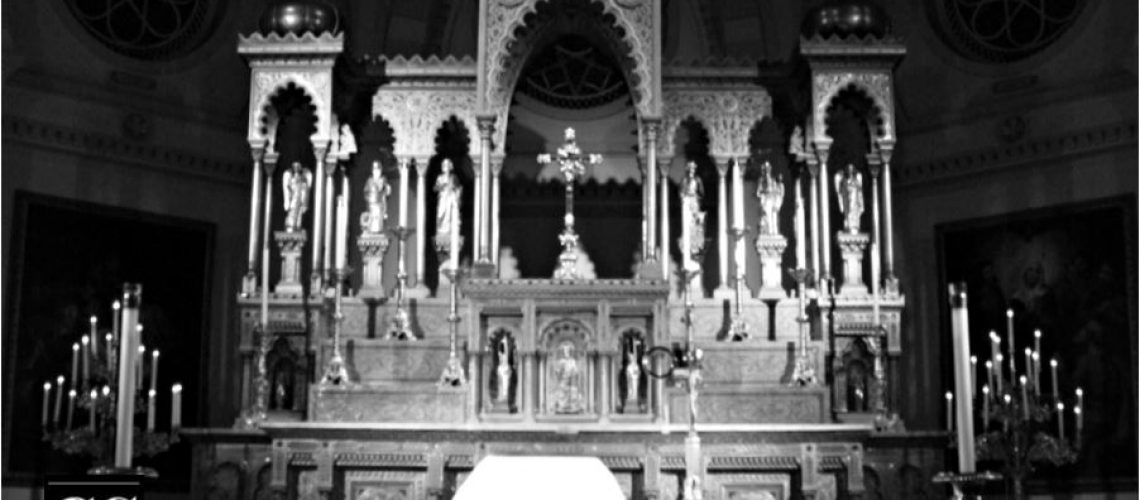
The History and Symbolism of Altars
What about altars? Do they have symbolism as well? Indeed, in the Old and New Testaments altars are places of sacrifice. Some have noted that the patriarchs erected altars in places where God has changed their lives.
In Peter’s first letter, he also exhorts us to be incorporated to Christ: “Come to him, a living stone, rejected by human beings but chosen and precious in the sight of God, and, like living stones, let yourselves be built into a spiritual house to be a holy priesthood to offer spiritual sacrifices acceptable to God through Jesus Christ” (2:4-5). Christ is the living stone, the spiritual bedrock of our faith. On the altar, we offer the re-presentation of Christ’s sacrifice, a sacrifice that should change our lives for the better.
The Stuff of Altars
So, of what should the altar be made? How should it be structured? The introduction to the Roman Missal (the Missal is the book that priests use which contains all the prayers needed for the Mass), gives some insights into . The whole text can be found here.
A couple of points are worth considering:
- It is desirable that in every church there be a fixed altar [meaning, attached to the floor and cannot be moved], since this more clearly and permanently signifies Christ Jesus, the Living Stone (1 Pt 2:4; cf. Eph 2:20).
- The altar should be built separate from the wall, in such a way that it is possible to walk around it easily and that Mass can be celebrated at it facing the people, which is desirable wherever possible. Moreover, the altar should occupy a place where it is truly the center toward which the attention of the whole congregation of the faithful naturally turns….
- In keeping with the Church’s traditional practice and with what the altar signifies, the table of a fixed altar should be of stone and indeed of natural stone. In the Dioceses of the United States of America, wood which is dignified, solid, and well-crafted may be used, provided that the altar is structurally immobile. As to the supports or base for supporting the table, these may be made of any material, provided it is dignified and solid.
- The practice of the deposition of relics of Saints, even those not Martyrs, under the altar to be dedicated is fittingly retained.
Christ Centered
Here we see that symbolism clearly laid out: the altar should be of stone, because it best represents Christ, the cornerstone of our faith. Likewise, the altar should be in a place “where it is truly the center toward which the attention of the whole congregation of the faithful naturally turns.”
In other words, the altar should be the center of attention at Mass. This is because it represents Christ, who is at the center of the Mass and should be at the center of our lives.
Finally, the altar should contain relics of the saints. This might seem strange, but then again, recall that the priest kisses the altar as he approaches it for the celebration of Mass. Why such an odd gesture? The kiss is a sign of affection and greeting, a sort of salutation for the Church in heaven, from the Church that is still below, struggling.
Conclusions
With these principles in mind, we can see why the Church encourages certain practices. Of course, there might be disagreements about the best way to implement these ideas. For instance, many disagree about whether the altar should be in the center of the Church or in a different location. But the Church does give us principles by which to think and discern.
When we examine the historical and symbolic value, a whole new world opens to us. The past does speak to us. If we listen we can recognize these things for what they are. They are signs that point us beyond this physical realm to the supernatural.


[…] and Analysis:Incensed About the Incense, Altered by Altars – Fr. Nathaniel Dreyer at Catholic StandBishop Paprocki Rebukes Spirit of Vatican II […]
The American Indians have used sage for the purpose of consecration and cleansing, smudging objects and especially people for millenia. There use of a sacred (fire) circle has the same goal, to focus participants and acknowledge the four cardinal points. When gathered around this earthen ‘altar’, a talking stick is passed to each in turn to praise the
great Spirit all all the blessing derived. Good essay, Fr Nate.
I agree. Good essay.
A few years ago my son and I visited a church in Quebec City. Of course, filled with designs and patterns and statuettes etc. I didn’t raise him in any particular faith and it was probably only the third or fourth time he had ever been in a Catholic church. As I pointed out to him, “Every little thing you see, has a meaning behind it.”
Hi Ordinary Papist,
Thanks for reading and for your comment! Yes, both incense and altars have a lot of story in history.
God bless!
Fr. Nate
Hi CaptCrisis!
Yes! That is very true: all those little things have their meaning.
God bless, and thanks for reading!
Fr. Nate