
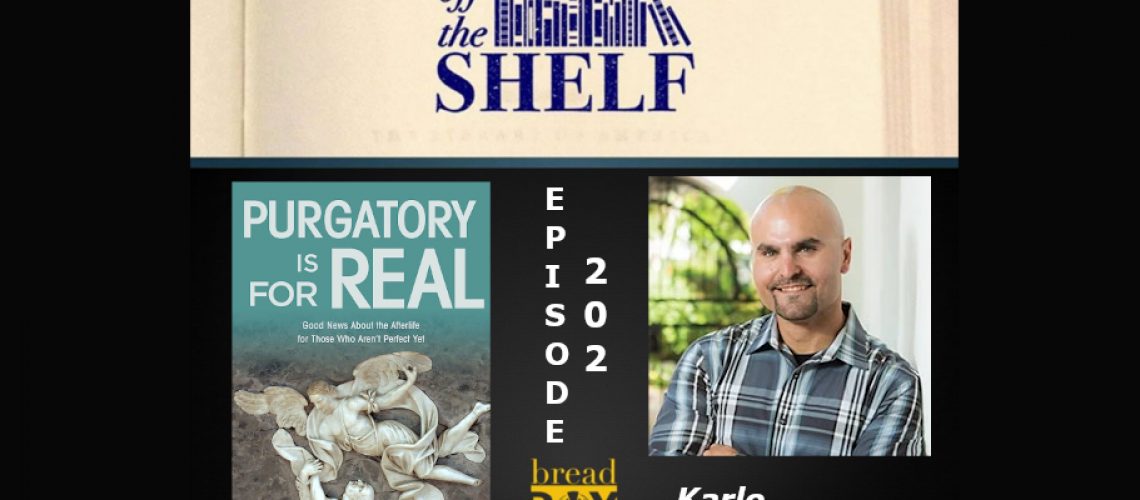
Off the Shelf 202 – Karlos Broussard
After a much needed break over the holidays I am BACK. This week I welcome my friend Karlo Broussard. We take a deep dive look at the often confusing topic of Purgatory. Yes folks, Purgatory is real and Karlo’s fantastic book Purgatory Is For Real : Good News About the Afterlife for Those Who Aren’t Perfect Yet lays out all the truths. Get your copy here.
From the publisher Catholic Answers
To many people, even many Christians, purgatory is a fantasy or worse, a wicked lie invented by the Church to make salvation complicated and keep people in fear. But apologist Karlo Broussard says that purgatory is fact, not fiction. The Bible supports it, Christians have historically believed in it, and it makes theological sense. In Purgatory Is for Real, he provides the evidence and reasoning to help you understand this controversial doctrine, and demonstrates how it is actually a joyful, hopeful reality not something shadowy and mysterious, but a sign of God s love and mercy.
Bio
Karlo Broussard is a staff apologist, author, and speaker for Catholic Answers. He travels the country giving talks on apologetics, biblical studies, theology, and philosophy, and is a regular guest on the radio program Catholic Answers Live. KarloBroussard.com. A native of Southern Louisiana, Karlo now resides in Southern California with his wife and five children.
Where to Find
I received a copy of this book in exchange for an honest review. Read my complete archives at www.catholicbookblogger.com


“The Bible supports it, Christians have historically believed in it, and it makes theological sense”
We’ll, I don’t find the term in any ‘Protestant’ Bible. My NJB hasn’t it either, although its index sends me to references; 2 Macc and 1Cor 3:15. The NJB’s excellent introduction to the Maccabean writings agrees with most other authorities. It acknowledges that 1 Macc is useful for Jewish history down to this day, but 2 Macc is fabulous – in the old sense; not as a compliment. (I do know the passage and how some RCC teachings find themselves there.) Paul discusses a process of purgation at Corinthians, but not how I understand it from RCC thought. He talks about fire burning away “works” of a man, a would-be Christian, not the man himself. This thought is in line with Peter’s thought at 1 Pet 1:7. He, Isaiah (1:25) and Ezekiel (22:18 ff.) all refer to the use of heat to refine gold and silver. The dross is discarded, not reserved for torture in hell- or any other kind of fire. I understand how Paul is used by the RCC, but it requires too much mental gyration on my part, even allowing for Peter’s comment at 2 Pet 3:15.
Christians of all persuasions have believed many things in the course of history. I count very few of those as reliable, trustworthy authorities.
It’s at theological sense that I definitely part company with Mr Broussard. When the ‘study of God’ is introduced I go immediately to the Book he had written for just that study.
Short version: At Genesis ch. 3 Yahweh condemns Adam to death in his original state – dust. For how long? For eternity, as far as we can say. Dust is not capable of feeling the “pains of hellfire” or purgatory. Adam was given life on God’s terms; he failed. We inherited sin and death from him, as a sort of genetic defect. (No children until Gen 4.) Into the Christian era, and death still holds sway over us. Paul traces the path I just did, at Rom 5:12; he shows us the saving ransom at v. 17 et seq. We’re saved by that, not purgation or torture. Moreover, he points out a common principle of law, part of legal codes in every civilized nation: no double jeopardy at Rom 6:7, and v. 22 ends his (and my) discourse with the proverbial phrase, “the wages of sin is death”. Death, not life in hell or purgatory.
Does that make sense?
Dear Doug Pruner,
Thank you for this useful and rational explication!
It saves us from believing in a vengeful God.
Nevertheless as limited beings we can*t know how the suffering
of million people on earth, mainly caused by our way to build up
society/community, will be balanced or repaired.
Will any guilt on earth be “forgotten” or “undone” in “heaven”?
What about the victims of life: the tortured and injured and traumatised ?
This old question remains.
But indeed – in this life we are instructed to avoid/abolish any dirt and dust –
and to find the pure gold of godly love within our lifetime.
[…] Purgatory is for Real: Off the Shelf with Karlo Broussard – Pete Socks at Catholic Stand +1 […]
[…] Purgatory is for Real: Off the Shelf with Karlo Broussard – Pete Socks at Catholic Stand +1 […]
Dear Pete!
Of course purgatory and hell are real – here on earth!
All people who suffer from hunger, water scarcity, violence and war, who are disrespected, abused, oppressed or exploited, live in an intolerable state of crying out for redemption. Ultimately, we all suffer from lovelessness and indifference and are dependent on the care of God – often in a loving affection of a person who perceives us.
Come Lord Jesus! Maranatha!
They are real in the next life too.
Martin, those are good questions. Since they have to with God’s attitudes and powers, let’s use the Book he gave us.
You write, Will any guilt on earth be “forgotten” or “undone” in “heaven”?
You may be in mind of the popular idea that we are born on earth but that our final destination is heaven, as reward for a good life. What does the Bible say?
Please read Gen 1:28. Where did God put Adam and Eve? Under what conditions?
Now please read Ps 115:16 and Isa 45:18 in your own Bible.
Based on what you’ve read, where is man’s home?