
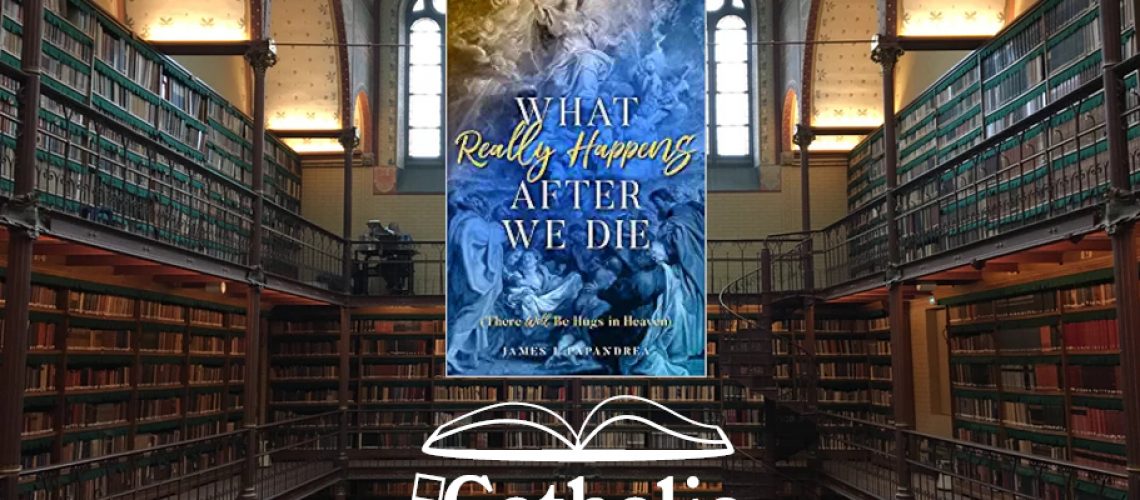
Death is not a topic many of us want to think about but it’s an occurrence that we will all have to face. No matter how hard we try eventually our earthly bodies will give out and we are faced with what next? Our choices here affect what our eternal outcome will be. So if we do the right thigs and make the choices what will our eternal reward look like? Jim Papandrea tackles this question in his book What Really Happens after We Die: How We Know There Will Be Hugs in Heaven!
This book was a very compelling read for me. Many of us ponder this question as we find our age increasing, time slips by, and we watch parents and elderly relatives pass away. Where do they go? If heaven is the ultimate reward as we believe and are taught…what is it like? Well as Jim tells us it’s a number of things. Heaven is a reunion. It is a party. Heaven is our hope?
Throughout the book Jim clues us in on how we can be confident in all these things. He masterfully uses a number of the parables of Jesus Christ to show by updating them into modern scenarios we can all relate too. Recall the parable of the laborers (Matt. 20:1-16)? Jim tells a story of a man hiring workers for his construction crew. The parable of Lazarus and the rich man (Luke 16:19-31) is retold as a man who has climbed the corporate ladder, passes by a homeless man on the way to his office daily, and dies….only to find the homeless in heaven and himself in hell. These modernizations of the parables brought a new sense of reality to them and really drove their stories home. These all brought to light the HOW and WHY we get to heaven or…that other place. Hint, your destiny is in your hands.
With the how and why established Jim explains what heaven is not. Firstly we do not all become Clarence’s from It’s A Wonderful Life. Alas we do not become angels. The Church Fathers explain clearly that this would be a transformation into another being and this is simply not Church teaching. Rather, what does happen. Is we become new. Our souls separate from our bodies and eventually will be reunited once more except this time…..in perfection as we were meant to be before sin entered the equation.
Another fascinating area Jim covers in the book is the topic of ghosts. One of my favorite topics has always been the Gettysburg battlefield, which is where I was born and raised and was my stomping grounds during my teen years. There are multiple tales of ghosts around the battlefield grounds and there is good reason for that a s Jim clears up. The Church Fathers understood and taught that ghosts are a real possibility and they are the result f people dying who were too attached to the things of this earth. This can serve as a real eye opener for many of us.
I’m simply scratching the surface here. There are a plethora of questions that Jim explores in the pages of this book. If you have any curiosity or concern on what heaven will be like than I encourage you to read this book. And a gentle reminder. Don’t fear death. Follow the lesson Christ himself taught us and your eternal world will be so grand words won’t be able to describe it!
Where to find
I received a copy of this book in exchange for an honest review. Read my entire archives at www.catholicbookblogger.com


A minor point on the ever recurrent subject of Ghosts: From the Old Testament to tradition of two milenia, it was believe that ghosts were real and had a purpose. This does not affect belief in the permanent soul or bodily resurrection. It simply means that God permitted the soul as manifested by a usually visible spirit, to carry a message to an intended person or persons. Good example is the “voices” heard by St. Joan of Arc. There are a number of other recorded appearances that clearly carry a spiritual message. It would seem that in addition to that purpose, it reminds of that eternal life is real.
Or are they demonic spirits,i.e. 1/3 of angels following Satan, seeking to deceive us?
Hence, the warning in Leviticus 19: 31.
“Seems that some of the RC Catechism contradicts the Scriptures, hence, my consternation. Also some of the statements by priests at mass, or quotes from the pope, leave me wondering why we don’t closely consider all of the words of Jesus?”
Yes, it does seem so at times but that is why Christ told his apostles to go and “teach all nations”. Some say that the scriptures are self explanatory but they are not always so clear because we would not have so many different interpretations as we do today, that is why it is of the utmost importance to look towards the Church for teaching for it is upon her and the apostles that Christ sent the directive to ‘teach all nations. ‘ We are not a solo scriptura faith. Church has always looked to Apostolic Tradition, scripture and the Magesterium as a guide to understanding. Christ told his apostles that “he who listens to you listens to me” is telling them it is Christ who is teaching through the apostles and they who would come after them.
Remember, before the scripture of the New Testament the Church and her apostolic Traditions existed. Scripture is Traditions written down. Christ’s promise that the gates of hell will never prevail against the Church is assurance that Christ will never lead us astray to those who are faithful to his Church.
Yes, somethings are difficult to handle Robert but then again, it is for this that we are called to have faith.
Just need to point out here that the “Church” in the Book of Acts was the Jerusalem Church and the first followers of Christ were Jewish. As Peter confessed, “You are the Messiah, the Son of the Living God!”
Jesus didn’t come to start a new religion, but fulfill the prophecies in the Old Testament. He was a devote Jew and did not come to change the Law.
Your quote of the scriptures deals with the 72 who went forth when Jesus was in the midst of his earthly ministry. Are you really suggesting that after almost 2,000 years the same message is being spread?
Take a serious look at the history of the Catholic Church and what has happened in almost 2,000 years. It is not the same as when Jesus walked in the promised land, is it?
Robert. I take my teaching from the Catechism.
Question:
What is the official church teaching on what happens after our earthly bodies die: Are we “dead” until Judgment Day or do we immediately go to heaven, hell, or purgatory?
Answer:
Although physical human bodies die, human souls never die. The Catechism of the Catholic Church teaches that every spiritual soul “is immortal: It does not perish when it separates from the body at death, and it will be reunited with the body at the final Resurrection” (CCC 366).
So at the moment of death, the soul separates from the body, is judged immediately, and enters either heaven (immediately or through purgatory) or hell.
Each man receives his eternal retribution in his immortal soul at the very moment of his death, in a particular judgment that refers his life to Christ: either entrance into the blessedness of heaven—through a purification or immediately—or immediate and everlasting damnation. (CCC 1022)
https://www.catholic.com/qa/what-happens-to-our-bodies-immediately-after-we-die
Also from scripture:
Luke 16:22; 23:43; 2 Cor. 5:8; Phil. 1:23
Luke 16:22 is part of a parable. But the scripture says “bosom of Abraham”.
Luke 23:43 uses the word “paradise”, which can mean garden.
2 Corinthians 5:8 is part of Paul’s discourse about our longing for the future with God. Same for Philippians 1:23.
I want to call your attention to Paul’s last letter, 2 Timothy 4:8;
“From now on a merited crown awaits me; on that Day the Lord, just judge that he is, will award it to me – and not only to me, but to all who have looked for his appearing with eager longing”. Sounds like the Second Coming, not when Paul died.
Seems that some of the RC Catechism contradicts the Scriptures, hence, my consternation. Also some of the statements by priests at mass, or quotes from the pope, leave me wondering why we don’t closely consider all of the words of Jesus?
To Ordinary Catholic:
What scripture are you quoting about the faithful souls awaiting in the bosom of the Father?
What about Paul’s words in 1 Corinthians 15?
If the disciples are not asleep in the grave, why did Jesus say he would come back for them?
What about Paul’s words in 1 Timothy 6:14-16 about immortality?
Daniel is told in Chapter 12 to “go, take your rest, you shall rise for your reward at the end of days.”
Or how about the words from Ecclesiastes 9:4-10?
And yet Jesus said in John 3 that no one has gone to heaven.
Later in John 14 he tells his closest followers that he goes to prepare a place for them and will come back for them.
When Cain killed his brother, God didn’t say that Abel arrived in heaven. See Genesis 4:10.
In Job 14 we are told “ so men lie down and rise not again. Till the heavens are no more, they shall not awake, nor be roused out of their sleep.”
Paul tells us in 1 Corinthians 15 that those who belong to Him will come to life again at his coming. Further in the same chapter Paul tells us that this takes place at the last trumpet, which is the 7th Trumpet in the Book of Revelation.
In 2 Thessalonians 2 Paul tells us that our gathering to the Lord takes place after two events – the great apostasy and the revealing of the antichrist.
Seems that the dead are awaiting the Resurrection, which has not yet occurred.
The Resurrection is just that, the “Re”surrection of our body that is now dead because of our mortality. The soul continues after our physical death because it is immortal, not the body. Our humanity is not complete until we are reunited with our bodies, new bodies. If the eternal life of our soul was the only thing of importance the “Resurrection” of our bodies would not matter. Yes, the general Resurrection of all the dead has not occurred, but the faithful souls are awaiting in the bosom of the Father until the Resurrection.